
Statements
Please find our latest statements below.
Advance Illinois Statement Regarding the FY27 State Budget
In the midst of ongoing fiscal pressures at the state level and uncertainty on the federal front, the Illinois General Assembly passed a “steady-on” budget that, while short on bold moves for our education system, reflects a continued prioritization of Illinois children, students and families.
“We recognize and appreciate the efforts of the General Assembly across early childhood, K-12, and higher education,” said Robin Steans, president of Advance Illinois. “While there is more to do, particularly in higher education, it is clear the state remains committed to strengthening opportunities for students.”
Key Takeaways
EARLY CHILDHOOD EDUCATION AND CARE
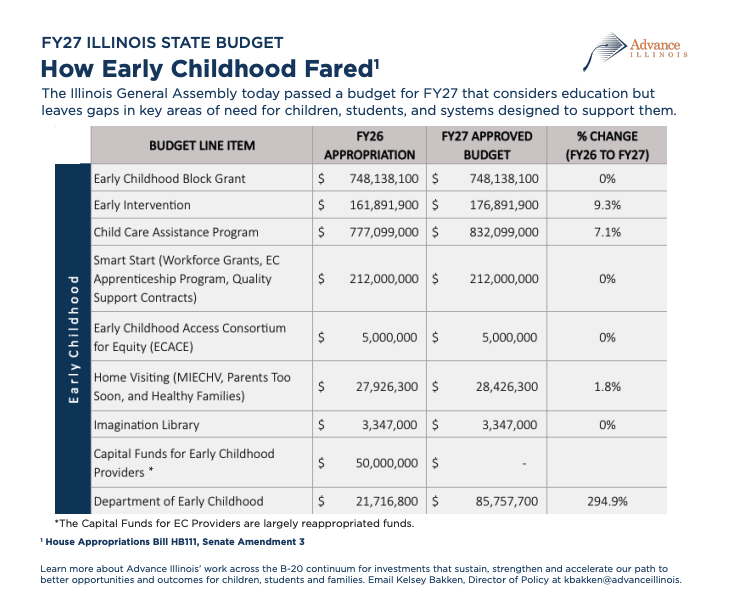
In the FY27 approved budget, we see the state working to maintain progress for children and families amid ongoing fiscal constraints and significant federal changes. That said, this maintenance approach to spending in key areas falls short of meeting the needs of the early childhood workforce, providers, and the young children they serve. We are therefore pleased that the General Assembly increased funding ($15M) for Early Intervention (EI). This is a step in the right direction, but more needs to be done to reduce wait times for young children with developmental delays and disabilities, and to better compensate the EI workforce. We also applaud the $55M increase for the Child Care Assistance Program (CCAP) for FY27. The increase helps address the growing need for home childcare providers, though it fails to increase reimbursement rates for childcare centers. Flat funding for the Early Childhood Block Grant, Smart Start Workforce Grants, Early Childhood Access Consortium for Equity (ECACE), and Home Visiting were undoubtedly hard choices, and the work ahead on these critical programs is clear. In particular, it is critically important that Illinois find a way to increase investment in ECBG to expand access to high-quality pre-K.
K-12 FUNDING
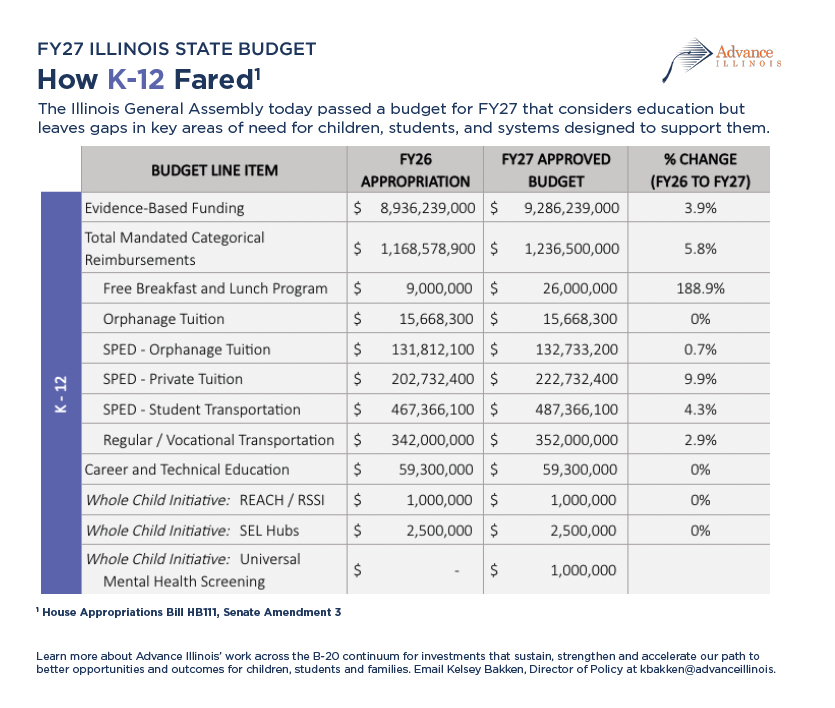
As the 10-year anniversary of Evidence-Based Funding approaches, we applaud the General Assembly’s steadfast commitment to funding the formula to ensure every school district remains on a path to full funding – even in a strained budget year. Continued investment through the formula is delivering meaningful progress across the state. Since 2017, the formula has reduced the number of severely underfunded districts—those receiving less than 70 percent of the resources they need – from 459 districts to just 56 districts in FY26. All the same, should Illinois continue to invest at the rate of $350M (with about $50M of that for Property Tax Relief Grants), our system will not reach full funding before 2040— when today’s kindergarteners will have graduated high school. Currently, three out of four Illinois students still attend school in districts that are not fully funded, with a statewide gap of more than $3B remaining to reach adequacy. Parents, students, and educators experience the consequences of these funding gaps, especially those in under-resourced communities with the greatest need.
We also appreciate other efforts to support our K-12 system. The FY27 appropriation for Mandated Categoricals (MCATs), an increase of $67.9M, reflects a greater increase than we have seen, and it will help address inflationary pressures. That said, without more significant growth to these operational necessities, proration rates will likely worsen with rising claims. While we appreciate the increased allocation for the Free Breakfast and Lunch Program to buttress against the loss of the federal funds, stable and adequate funds remain as important as ever, particularly amid unacceptable proration rates for other key services like transportation and special education tuition. Looking ahead, lawmakers must find a way to increase the state’s rate of investment for both EBF and MCATs to make sure every school district is sufficiently funded to effectively serve their students.
EDUCATOR PIPELINE
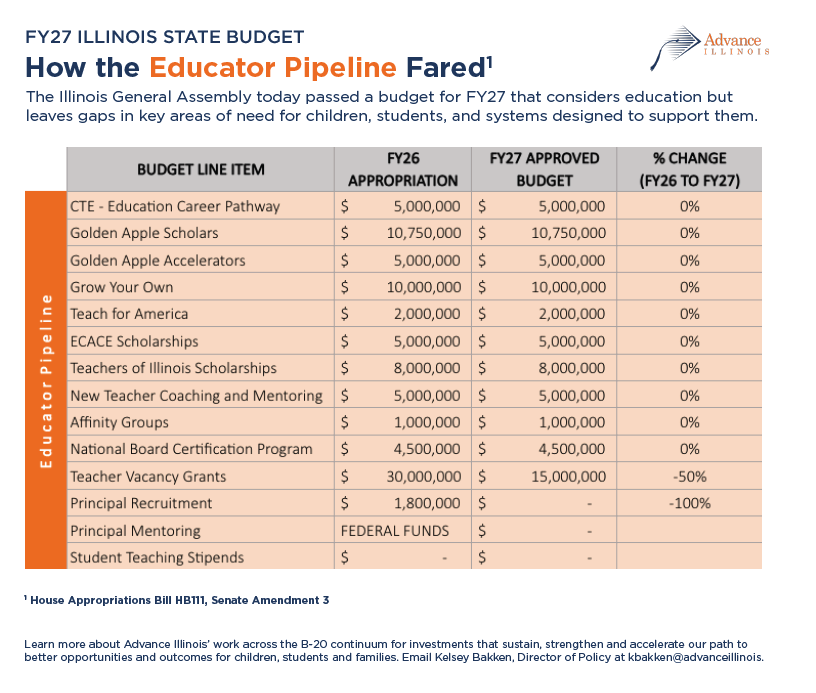
Like many other states, Illinois needs to strengthen and diversify its educator workforce. The approved FY27 state budget presents concerns, but manages to maintain some key programs.
And while we would like to grow proven pipeline programs such as Golden Apple Accelerators, Grow Your Own (including the Diverse Male Teacher Initiative), Teach for America, Teacher Vacancy Grants, and new teacher mentoring and induction, we appreciate that these programs were maintained. At the same time, we are disappointed to see that critical Principal Recruitment and Mentoring programs were not funded in the new budget. Further, paid student teaching was not funded in the new budget. This is a critical program that would help recruit and train qualified teachers, while reducing financial barriers for candidates interested in the profession.
CARING FOR THE WHOLE CHILD
We are pleased to see that Illinois continues to prioritize investment in programs that help schools address growing student mental health needs. In a tough fiscal environment, we appreciate the legislature’s approval to maintain level funding for Resilience-Supportive Schools Illinois (RSSI) and Social-Emotional (SEL) Hubs, and are pleased to see funds allocated ($1M) to support the roll out of Universal Mental Health Screenings.
HIGHER EDUCATION
MAP
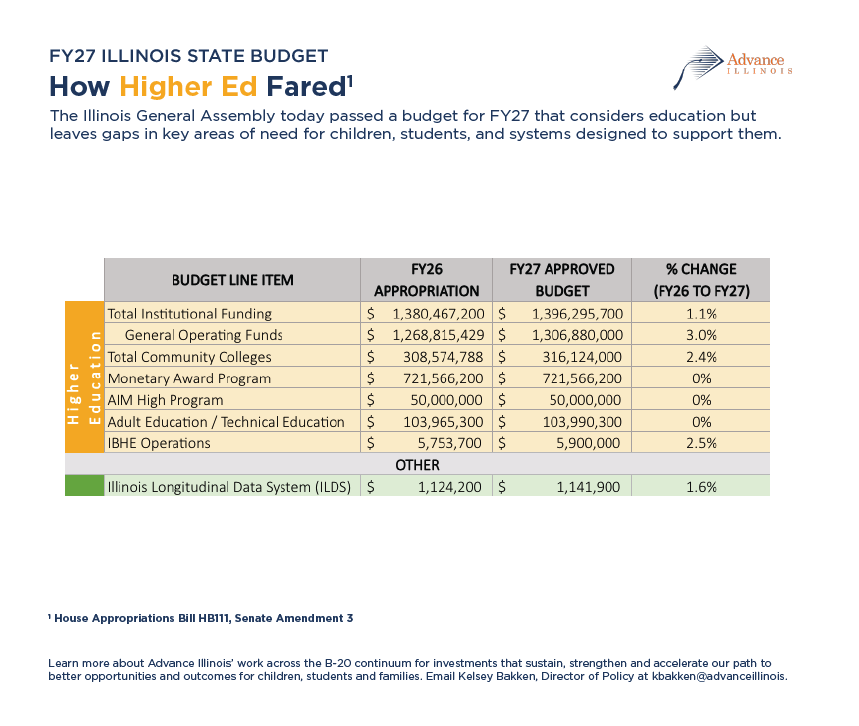
The Monetary Award Program (MAP) is a lifeline for college access, so it is disheartening that the General Assembly approved flat funding for FY27. Without additional funds, we are likely to see the continued suspension of MAP grants next year, leaving otherwise-eligible applicants without support because funding has run out. This means more students will have to take out loans, work long hours, and/or only attend school part-time to make up the difference—if they decide to attend college at all. Importantly, MAP now covers only 47% of what it costs to attend a public university in the state, so those students who receive a grant still have a significant way to go in covering the true cost of attendance. Given its purpose of supporting students with financial needs, underfunding MAP harms Illinois’ students from low-income households, and treats higher education as a privilege for some, rather than a resource for all. We recognize the financial pressures on the state, but the lack of a MAP increase runs counter to the goal of expanding access, affordability, and equity in higher education.
INSTITUTIONAL FUNDING
As we continue to work with lawmakers and collaborate with advocacy partners in calling for the passage of the Adequate and Equitable Public University Funding Act (SB13/HB1581), our state must prioritize distributing new funds in ways that respond to the different needs facing Illinois’ 12 public universities.
We appreciate the General Assembly approving a 1% increase from FY26 for public universities in a tight budget year. That said, the increase does not begin to match inflation for a system that is already deeply underfunded. As importantly, the across-the-board increase approved for FY27 maintains the (inadequate) status quo for our public universities overall and represents a missed opportunity to allocate new funds based on mission and need. Illinois’ students deserve affordable access to quality, well-resourced institutions that have the wherewithal and programs they need to thrive and graduate. In short, Illinois’s students deserve better.
This cannot happen without the state stepping up and revamping its approach to funding our public universities. If the state does not identify a sustainable revenue source to fund the Adequate and Equitable Public University Funding Act, then we urge the legislature to make it a priority going forward to distribute any new dollars equitably and in a manner aligned with the goals of the bill’s formula.
PROTECTING PROGRESS FOR STUDENTS IN FACE OF FEDERAL CHANGES
We applaud the state’s ongoing work to respond to federal changes in funding, data collection, eligibility for safety net programs, and civil rights enforcement. The impacts of federal decisions and cuts are being felt already and will have implications over time that affect educational quality and access and family stability. We are therefore pleased to see funding ($200,000) to support ISBE in developing a new way of counting students from low-income households, as it is certain that student eligibility will drop due to SNAP changes approved in H.R.1.
In Conclusion
We appreciate the General Assembly for sustaining critical areas of work and progress while tackling fiscal pressures at the state level. These pressures - exacerbated by federal changes - intensify the urgency for state action and investment to protect and improve outcomes across the B-20 system. As we look ahead, we will continue to collaborate with advocates and state leaders to ensure our education system can provide what Illinois children, students, and families need to flourish. The future of our state depends on it.
Advance Illinois Statement on Governor Pritzker’s FY27 Budget Recommendation
In the face of a tight budget year and continued uncertainty due to federal funding instability and policy changes, Illinois leaders face difficult decisions. We appreciate Governor Pritzker’s focus on fiscal responsibility, while continuing to prioritize children, students, and families. Today’s budget proposal reflects an ongoing, albeit restrained, commitment to education.
“Governor Pritzker has consistently prioritized education, and past investments have served Illinois well,” said Advance Illinois President Robin Steans. “We hope the General Assembly can find ways to build on the Governor’s proposal to ensure that Illinois students do not lose ground.”
Early Childhood
As Illinois fights a possible $1B loss in federal childcare funding, and navigates the transition of early childhood and care programs to the new Illinois Department of Early Childhood (IDEC), we applaud the Governor’s continued support for the agency and a $55M increase to meet growing demand for the Child Care Assistance Program (CCAP). And while more is needed, it is good to see an increase of $15 million in Early Intervention to support rate enhancements for providers. We hope the General Assembly can find a way to boost Smart Start Workforce Grants - a program that plays a crucial role in bolstering childcare workforce recruitment, retention and compensation, which in turn anchors the system as a whole, and can increase the Early Childhood Block Grant, kept level for a second year in a row.
Educator Workforce
Given the ongoing need to strengthen and diversify the educator workforce, we are pleased to see continued funding for many educator pipeline programs. At the same time, flat funding for scholarships like ECACE means that we are unable to meet the staffing crisis in early childhood. Additionally, funding was reduced for some programs, like Golden Apple Accelerators, while others were eliminated entirely from the budget, including new principal and teacher mentoring and Affinity Groups. Without funding support, these programs leave new educators, particularly educators of color, without crucial early career supports – supports that have been shown to increase both effectiveness and retention. We urge the General Assembly to restore these funds – modest investments that yield outsized benefits.
K-12 Funding
Despite notable progress, Illinois public schools still face a $3 billion gap to full adequacy. Accordingly, we appreciate the Governors' recommendation to increase Evidence-Based Funding (EBF) by an additional $305M – the state’s single most effective means to equitably and adequately support students. We also applaud the Governor’s proposal to address growing shortfalls in Mandated Categoricals (MCATs) by increasing this critical budget line by $51M to help keep pace with costs for legally-required services for special education facility tuition, orphanage tuition, the free and reduced meal program, and transportation. MCATS are deeply underfunded, putting a strain on local school finances and services, so we appreciate the prioritization of both of these funding streams in the Governor’s budget.
Whole Child
It is critical that Illinois continues to invest in programs that help schools address growing student needs, as evidenced by ongoing chronic absenteeism and elevated mental health challenges. While the budget proposes $3.5M in support for Resilience-Supportive Schools Illinois (RSSI) and SEL Hubs for professional development, planning, and programming across the state, we hope the General Assembly will do all they can to find additional dollars to ensure these efforts meet the growing mental health needs across the state.
Higher Education
At the postsecondary level, IBHE requested a 3% increase for public universities and community colleges. Critically, IBHE proposed that new funding be distributed equitably, rather than evenly – a recommendation they have made for the last four years and one we share.
Sadly, the Governor’s proposed budget falls short of these requests. On the institutional side, the Governor is proposing a disappointing 1% increase for public universities and community colleges. This increase is disappointing for several reasons: It does not keep pace with inflation, and on top of the meager 1% increase from last year, it compounds already serious financial strains in higher education – strains exacerbated by federal instability. This will have the predictable effect of worsening affordability at a time when Illinois postsecondary enrollment remains a concern. This proposal underscores the need for a structural change to how Illinois funds its public universities and the need to move to a funding formula that puts the state on a stable, predictable path to adequacy, and does so in a way that takes the unique mission and enrollment of each campus into account. Absent such a change, the vicious cycle of under-funding and enrollment challenges will continue.
We are similarly disappointed to see MAP held steady. We appreciate the significant MAP increases in years past (which the Governor has championed) and hope the General Assembly can find a way to move closer to the $70M increase recommended by stakeholders – an amount that meets growing need.
A bright spot in the higher education space is the Governor’s proposal to address deep and serious deferred maintenance – suggesting $300M in new capital funds for universities, and $100M in new funds for community colleges.
We appreciate the Governor’s ongoing commitment to education and the decisions he and other state leaders must make amid challenging circumstances. That said, more can and must be done for Illinois’ children and students. We now look to the General Assembly and encourage them to maintain hard-won progress and support Illinois students reaching their full potential amid a tumultuous federal landscape.
Advance Illinois Statement on the ISBE FY27 Budget Recommendations
Today the Illinois State Board of Education (ISBE) approved and sent to Governor Pritzker recommendations for its FY27 Budget. Even in a tight fiscal year, our state continues to rightfully prioritize investing in students, teachers, and schools. In general, we applaud the budget recommendations, though there are some absences that will require further attention from the Governor and General Assembly.
K-12 Funding
In its FY27 budget proposal, ISBE recommends increasing the appropriation for the Evidence-Based Funding (EBF) Formula by an additional $350M, which affirms the state’s commitment to making good on its promise to fully fund schools by growing EBF. We applaud the continued commitment to EBF, even as we urge legislators to recognize that our current level of funding is not sufficient to bring schools to adequacy within the next 15 years. That means an entire generation of students will continue to learn in underfunded schools. The state’s commitment to schoolchildren needs to be more than what is legislatively mandated. Instead, we must focus on what is required to close the gap for underfunded schools and the students they serve.
Along with the passage of EBF in 2017, the Property Tax Relief Grant (PTRG) was established to provide districts with high property tax rates an opportunity to lower the property tax burden on local taxpayers by having the state replace a portion of foregone tax revenue with state funds. PTRG was funded at nearly $50M per year until it went unfunded in FY2026 due to the tight fiscal environment. The Professional Review Panel continues to develop its recommendations around this program, awaiting a forthcoming analysis that examines whether the tax relief program performed as intended. If for any reason the Governor or General Assembly choose to again withhold PTRG funds, we would hope and expect state leaders to redirect that $50M into EBF tier funding to make up for lost EBF funding from 2021, and to help close ongoing gaps to adequacy.
At the same time districts face rising costs due to inflation, costs are also rising for Mandated Categoricals (MCATs), which cover special education facility tuition, orphanage tuition, the free and reduced meal program, and transportation (a vital cost center). These rising costs, combined with persistent underfunding, have driven MCAT reimbursements to an unacceptable level - one that is putting additional financial pressure on districts. Indeed, some MCAT proration rates have fallen as low as 60%. ISBE’s recommendation to increase funding for MCATs by $151.5M represents the investment needed simply to maintain current pro-ration levels for another fiscal year. Significant, continued investments are needed for FY27 and beyond to ensure schools can provide the essential services covered by MCATs, and can do so without cannibalizing EBF dollars needed elsewhere. The bottom line is that MCATs make learning possible—and support the equity-focused dollars going out to districts through Evidence-Based Funding. We appreciate the prioritization of these funding streams in ISBE budget recommendations and support increased funding for MCATs.
Student Well-Being
At a time when student well-being continues to be a clear issue, as evidenced by ongoing, serious chronic absenteeism and elevated mental health issues, it is critical that Illinois continues to support systems that help schools address growing needs. We are thankful that ISBE is asking to maintain support for Resilience-Supportive Schools Illinois (RSSI) and SEL Hubs, programs that provide key professional development and training for schools, as well as access to outside resources. Illinois has invested in building and piloting these systems, and they are making a difference in schools across the state; maintaining them reflects ISBE’s commitment to building a more systemic approach to this work. That said, increased state support for RSSI is needed: The Center for Childhood Resilience, which built RSSI and the tools that it is based on, is preparing to scale RSSI across the state. An additional investment of $1 million is necessary to build the infrastructure to support that worthy and timely goal. Finally, we were pleased last year to see the General Assembly pass and Governor Pritzker sign into law SB1560, requiring all Illinois public school districts to offer mental health screenings. However, with no funding requested for this initiative in ISBE’s FY27 proposal, we hope the agency has a plan to smoothly prepare for and launch universal mental health screenings in 2027.
Teacher Pipeline
Like other states, Illinois confronts challenges across the educator pipeline, from recruiting to retaining diverse, excellent teachers. As schools continue to wrestle with teacher vacancies—Illinois had 1,970 unfilled positions in the 2024-2025 school year —ISBE has recommended that the Teacher Vacancy Grant (TVG) be transitioned from a pilot to a permanent program with a $30M annual appropriation. This program, aimed at addressing acute shortages across the state through targeted, flexible grant funding, would be the largest investment in the educator workforce in the state. We appreciate ISBE’s focus on this critical area, even as we hope legislators will consider whether such ongoing investment is best made by enhancing EBF, or by continuing this fund (both positive options).
Importantly, ISBE’s proposal to maintain funding for key programs across the educator pipeline, including Teach for America, Affinity Groups, and Principal Recruitment recognizes the critical nature of attracting future educators to the profession, supporting educators of color, and providing opportunities for growth and leadership in the profession. These are small investments with an outsized impact.
While we applaud many of ISBE’s recommendations, we are concerned that the budget proposal does not include dollars for either new teacher or new principal mentoring and induction. Both programs have track records of improving retention rates – a critical piece of the puzzle in lowering vacancy rates and strengthening the profession. While we recognize the growing pains in re-establishing these programs (after statewide disruption in years past), it is imperative that we maintain them. Stopping and starting this work undermines its impact and our long-term goals. We strongly encourage the Governor and General Assembly to maintain this funding.
We recognize the tough fiscal reality that leaders face in planning Illinois’ FY27 budget and commend ISBE for making student-centered recommendations in light of them. The agency’s budget proposal is a strong start, and we look to the Governor and General Assembly to address a few remaining, critical gaps. Never has the need for strong, steady state funding been more essential.
Advance Illinois Statement on the 2025 Illinois Report Card
Data in the 2025 Illinois Report Card offer a nuanced view of how Illinois K-12 schools and students are faring – with reasons to celebrate, as well as areas where further attention and work will be needed to ensure every Illinois student has the resources and supports needed to thrive.
"It is encouraging to see continued gains on some critical metrics and some narrowing disparities between student groups – Illinois students are continuing to recover from COVID, and it shows,” said Robin Steans, Advance Illinois President. “But inequities persist and some stagnating and worrisome data points underscore important ongoing challenges.”
Where We’re Celebrating
Most notably, Illinois students are graduating from high school at among the highest rates in years. This past school year, the 4-year graduation rate was 89% - reflecting an increase from the previous year and an ongoing upward trend. Importantly, continued improvement on this metric was seen across student groups, and while disparities persist, gaps are closing. Further, it is worth highlighting the strong growth of English Learners. Indeed, their gap to the overall graduation rate was 14.2 percentage points pre-pandemic, and has shrunk to 8.7 percentage points. This progress can be attributed to the tireless and collaborative work of educators, families, and the students themselves.
It comes as little surprise, then, that a key indicator for high school graduation - 9th grade on track – continues to improve as well. The 9th grade on track rate increased from 88.2% in 2024 to 89.3% in 2025. And while equity gaps persist across student groups, for Black students, the gap to the statewide average has shrunk markedly since 2019, from 12.1 percentage points to 7.8 percentage points in 2025. Students with IEPs also showed significant progress and are surpassing pre-pandemic levels.
Thanks to the Kindergarten Individual Development Survey (KIDS), we have a window into children’s readiness as they begin K-12 schooling. Since its launch in 2018, an overall increase in the assessment’s participation rate is allowing educators and state officials to gain more accurate insight into the needs of young learners. There has been significant growth in the percent of incoming kindergartners demonstrating readiness across all 3 developmental domains since 2018, and steady improvement in the number of students not ready in any area. That said, results were largely flat this year. We will continue monitoring these metrics closely – the survey being an important tool for identifying instructional and intervention needs early on to ensure every child gets a strong start in school.
What We’re Watching
In 2024, the state announced it would revert to the ACT for its required high school accountability assessment. At the same time, the state also changed the benchmarks it would use to report proficiency, and changed the way in which it shares data from this assessment. As we all adjust to these changes and although the ACT has undergone its own changes since the last statewide administration in 2017, it is worth noting that the composite score for state students on the ACT is 18.8, over a point below state composite averages when the ACT was last administered statewide. Moreover, using the proficiency rates reported by the state, it is clear that significant gaps in English Language Arts and Math exist across lines of race and income. While more administration of the test is needed to fairly assess how students are doing, 2025 Report Card data highlights significant gaps to the statewide averages for proficiency— 51.7% in Math and 39.3% in reading among student groups, and most demonstrably for Black and Latinx students.
Similarly, a recent change to IAR cut scores for determining proficiency means we are unable to compare proficiency rates from 2025 with those of 2024 and years prior. We expect to have access to the underlying scale scores in the coming weeks, and will plan to analyze and issue a statement on what that data reveal about the underlying gains that students may have experienced. Regardless, in the elementary grades, too, equity gaps persist: where White and Asian students outperform the state average, Black and Latinx students perform below the state average in both Math and ELA. Report Card data show that English Learners, students with disabilities, have IEPs or are from low-income households are also proficient at rates much lower than the statewide average. Indeed, students with IEPs have the lowest proficiency rate of any other student group, suggesting more targeted support is needed.
Stewarding our Educator Pipeline to Support Our Students
We applaud the state for its ongoing work to build the educator workforce. The efforts are paying off with ongoing and steady growth as the state added nearly 700 teachers last year. Since 2019, teacher FTE has grown by more than 5%, reducing class sizes considerably. At the same time, teacher retention is also high and surpassing pre-pandemic levels, posting a 3.8 percentage point increase from 2019. But there’s still work to do. Despite the increasing diversity of Illinois’ k-12 student population, teacher diversity improved just slightly last year. For example, although Illinois has more Latinx teachers, they represent just 8.9% of the teacher workforce, while Latinx students now represent more than 28% of all K-12 students in Illinois.
The Right Direction but ...: Chronic Absenteeism
In our latest report, The State We’re In 2025: A Report on Public Education in Illinois, we explored the various conditions impacting student learning – critical among them being a student’s time in the classroom. Chronic absenteeism (defined as missing 10% or more of school days regardless of excuse) remains one of the most alarming and persistent issues stemming from the pandemic. Where once (2018), average chronic absenteeism was just 17%, that rate rose dramatically and despite modest improvement, remains at 25.4% statewide. Worse still, chronic absenteeism is significantly severe for students of color (39.3% for Black students and 31.7% for Latinx students), for students from low-income households (35.1%), and other student groups. And chronic absenteeism is at an alarming 40.1% for CPS students. Research has long made clear the impact of absenteeism on student learning. A recent IWERC report underscored that since 2019, the negative relationship between IAR scores and days absent has worsened. For a 3rd grader in 2023, each additional day absent resulted in a 0.31 decline in IAR Math score compared to -0.26 for a 3rd grader in 2019. So while it is good news that chronic absenteeism declined by .9%, we have a great deal of work to do.
What the research tells us about the state of student mental health may offer some insight – from 2007 to 2023, the percentage of high school students who feel sad or hopeless grew from 29.6% in 2009 to 40.4% of students in 2023, and still that is a far cry from fully understanding what all is at play in keeping students out of school. It is therefore heartening to live in a state that is urgently working to understand what is impacting students and their communities – lately through tools like the Children’s Adversity Index – and do something about it through initiatives like the statewide initiatives implemented by the state included the SEL Hubs and RSSI. But the work ahead remains considerable. A deeply systemic approach to addressing childhood trauma is needed more than ever. Even now while there has been in a slight improvement in the ratio of school support personnel (nurses, counselors, school psychologists, social workers) to students, Illinois still trails the levels recommended to ensure every student can access care that supports their resiliency.
Finally, it is clear that postsecondary enrollment, which stood at 73% in 2019, has not yet recovered from the vicissitudes of COVID. According to the State Report Card, 66% of Illinois high school graduates enrolled in postsecondary within 16 months. CPS enrollment has also suffered, and 16-month enrollment stands at 64%, and while that number is down, it compares more favorably than the state as a whole. Importantly, at both the state and Chicago level, significantly more high school graduates are enrolling in 4-year colleges than 2-year – a gap that has widened.
In Conclusion
At a moment when school districts, communities, educators, families, and students are being asked to navigate and respond to significant challenges, we want to recognize the real improvements we have seen in kindergarten readiness and high school graduation since 2018. But we would be remiss not to point out where the data tell us there is tough work ahead. Our chronic absenteeism, along with languishing ACT scores and postsecondary enrollment rates remind us that the impact of COVID is still being felt, and we need to double-down on both rigor and support. And while we are adding needed staff and retention rates are stable and relatively high, teacher attendance suggests that classroom professionals are also feeling the strain of ongoing student mental health issues.
As for elementary academic progress, changes in IAR cut scores make it difficult to assess how much academic progress we made this past year. We look forward to reviewing underlying scale scores as they become available and revisiting this important issue.
In the meantime, let’s celebrate what’s working, and recommit to providing more rigor and more support.
Advance Illinois Statement on ISBE’s Release of The Children’s Adversity Index
Today, we applaud the Illinois State Board of Education’s (ISBE) release of the Children’s Adversity Index. We hope and expect the tool will positively impact general awareness of mental health issues present in every corner of the state, and inform the level and quality of support communities, districts, and the state provide students.
“The Adversity Index enables Illinois to better, more thoroughly understand and support the mental health and well-being of Illinois children and students,” said Advance Illinois President Robin Steans. “Whether that’s through more state investments, targeted healthcare services, or greater amplification of community experiences, this tool will help leaders see data on a variety of related factors all in one place and inform decisions that help students thrive.”
Passed into law in 2023 (P.A. 103-0413) and informed by findings from the Whole Child Task Force, the Children’s Adversity Index is research-driven and uses data from across a range of domains, including healthcare access, education access, economic conditions, and family and community stability. Considered together, these factors create unprecedented, useful, and transparent windows of insight into community well-being across Illinois.
Traumatic childhood experiences – often called Adverse Childhood Experiences – do not just happen in isolation, but impact and are impacted by the communities in which they occur.
A wealth of research shows the impact trauma has on students’ ability to focus, learn and achieve. The environmental view this Index provides offers the public and leaders at the district and state level critical insights into what resources and supports are needed to ensure every Illinois student’s needs are met. Importantly, the Index underscores that children in every region of the state are affected by trauma, and we need a statewide and systemic approach.
ISBE’s release of the Children’s Adversity Index marks an important step in the state’s ongoing efforts to respond to childhood trauma through schools, where studies show students are most likely to access mental health support and social emotional learning.
The release of the Children’s Adversity Index, while years in the making, could not come at a more critical time. Students and communities continue to grapple with the aftereffects of the coronavirus pandemic, including on mental health. The Index makes clear that our children need trauma-informed and –responsive resources in every school. At the same time, the Department of Education recently announced that it would end $1billion in grants for mental health services for children, removing critical resources despite ongoing need.
“Now that we have such important ground-level information, it is up to us to put it to good use – by paying attention and responding to the issues this index illuminates,” Steans said.
We celebrate the state’s continued progress in ensuring every district has what it needs to holistically support student well-being; this new Index underscores how urgent this work continues to be.
###
About Advance Illinois
Advance Illinois is an independent bipartisan policy and advocacy nonprofit organization working toward a healthy public education system that enables all students to achieve success in college, career, and civic life.