


Blog
Our blog provides readers an opportunity to hear from the Advance Illinois staff and partners on education policy issues affecting Illinois students and beyond.
Early Childhood Education and Care Is an Investment in Our Future
Our Early Childhood Education and Care is Essential campaign reviewed the impact of high-quality programs for children, families, communities and state, highlighting challenges for providers and the workforce. While there is more work to be done, Illinois is making progress in strengthening its early childhood education and care ecosystem, including with the recent launch of the Department of Early Childhood, a unified agency to better support families and providers. And continued investments in programs that help young children thrive and prepare for kindergarten show a commitment to our youngest learners, their families, providers, and the future of our state.
The research is clear, high-quality early learning programs improve educational, social, and health-related outcomes in children, setting the foundation for long-term well-being and academic success. School readiness is improved by building cognitive and social-emotional skills that children need to thrive in school. Research also shows that early experiences in the home, in other care settings, and in communities shape the development of a child's brain, particularly in the first five years. High-quality early learning opportunities are essential in giving Illinois’ youngest learners a strong start.
When childcare is unaffordable or inaccessible, it creates barriers, forcing many families to make difficult decisions, impacting their financial security, and young children’s stability. In 2026, 69% of children in Illinois have all available parents participating in the workforce, while the average cost of care is $19,807 a year (or $1,651 per month). Studies show that parents of children under age six needing to make job changes due to challenges with childcare, such as leaving or not taking employment. This has led to $172 billion in lost earnings and productivity each year involving families with children under age five, further impacting the economy. In Illinois alone, $6.2 billion was lost due to childcare challenges involving families with infants and toddlers. Fortunately, programs like the Child Care Assistance Program (CCAP) help families pay for childcare while parents work or attend school.
Where families reside plays a role in childcare access. An estimated 49% of Illinois children live in a childcare desert, with disproportionate impacts felt by low-income, rural, Latinx, and communities of color. In Illinois, CCAP participation rates varied widely by region. In some areas of the state, fewer than 20% of eligible children were enrolled, while in others, over 50% participated. These differences reflect local and regional accessibility, provider availability, and awareness of the program. To support working families and those eligible for childcare cost assistance, reducing childcare deserts and raising program awareness is a necessity.
The early childcare workforce also plays a pivotal role in the early years of our youngest learners, yet they are chronically undercompensated. Without educators, providers often have to reduce enrollment or close classrooms, creating greater access barriers for families. Investments in early educator pay and benefits are associated with improved retention in the early childhood workforce, stronger program stability, and better educator well-being. The Smart Start Workforce Grant (SSWG) program has allowed providers to improve staff wages while continuing to deliver high-quality education and care. In addition, providers receiving SSWG have a higher average enrollment of children receiving support through CCAP - increasing equity and enhancing access to families who need it most.
In recent years, Illinois has laid critical groundwork in early childhood care. With the Department of Early Childhood now a reality, the agency will support the state’s ability to identify gaps, and address challenges within the ecosystem. In addition, the forthcoming Early Childhood Integrated Data System (ECIDS) will bring early childhood data from across programs and agencies together to help Illinois better understand the needs of children and families, improve service, and make more informed decisions. There is also ongoing work to align funding and programming, ensure equity-based funding adequacy targets are set across service areas, and establish a strong regional infrastructure. As Illinois continues to strengthen the future of our state, sustained investments in these programs are critical to ensure every child and family can access high-quality early learning and care so they can thrive and succeed.
Eucarol Juarez is the Senior Communications Associate at Advance Illinois
The Early Childhood Force Driving Young Children’s Brain Development
Early childhood is a period of extraordinary opportunity and vulnerability, when the brain develops more rapidly than at any other time and lays the foundation for lifelong learning, behavior, and health. This development is driven by the quality of relationships children have with parents and other caregivers through everyday experiences. In that sense, adults who work with children are not just providing care, but actively constructing the developing brain. That is why supporting a highly-trained and stable early childhood workforce is best understood as an investment in young children’s healthy development.
Sadly, despite the critical role played by the early childhood workforce, Illinois, like many other states, faces persistent challenges in attracting and retaining talent. Low wages and scant benefits result in chronic shortages and high turnover rates, which in turn undermine the consistency and quality of interactions that young children need to develop. It is therefore urgent that we align policy and investment with what the science of early brain development tells us.
In the earliest years of life, the brain develops at a remarkable pace, with 90% of brain development occurring before age 5 and neural connections forming more rapidly than at any other time. This development is not automatic; rather, it is driven by children’s experiences, especially the quality of relationships they have with the adults around them that can either support and facilitate a child’s healthy development or stifle it. For example, for very young children, development occurs through “serve-and-return” interactions – the response from caretakers to a young child’s needs, emotions, or behaviors. These interactions quite literally build brain circuitry, shaping children’s language, social-emotional skills, and cognitive capacity. At the same time, early development is highly sensitive to adversity. Prolonged, unbuffered stress—often referred to as “toxic stress”—can disrupt developing brain architecture and have lasting consequences.ⁱ
As many young children spend substantial time in early childhood care and education settings, the quality of care provided plays a critical role in their cognitive growth, language acquisition, and development of social-emotional skills. In these settings, the relationships, interactions, and environments that young children need to thrive rely heavily on the skill and preparation of the adults providing care. High-quality, brain-building interactions require more than good intentions—they call for deep understanding of child development, the knowledge base to create enriching activities and experiences for young children, along with the ability to respond to children’s cues with consistency and intention. Importantly, without adequate training and support, these interactions and experiences can be inconsistent or ineffectual for young children. In this way, workforce preparation directly shapes the extent to which early educators can foster growth across developmental domains and help set young children on a trajectory for kindergarten and later academic success.
In order to effectively support children, promoting growth and kindergarten readiness, the early childhood workforce also needs to be stable. Young children rely on consistent relationships to form secure attachments and feel safe. High turnover—often driven by low pay, burnout, and challenging working conditions—disrupts these critical connections. High staff turnover disrupts the stable, responsive relationships young children need, undermining attachment, increasing stress, and negatively affecting their social-emotional and cognitive development.ⁱⁱ This makes workforce conditions not just an employment issue, but a child development issue. When early childhood educators are well-supported in their work - through stronger compensation as well as ongoing professional development, reflective supervision, and supports that help them manage stress and effectively support children with complex needs, children benefit from the stability and responsiveness those strategies generate.
When early childhood programs deliver high-quality programming, children are better equipped to enter a formal school setting. Unfortunately, gaps in kindergarten readiness continue to persist, with only 21% of children in poverty found to have the foundational skills they need to succeed upon entering kindergarten, compared to the statewide average of 31%.¹ According to the Harvard Center on the Developing Child, high-quality early relationships can buffer the effects of poverty and adversity, helping to close developmental gaps before they widen over time. In this way, investing in the early childhood workforce is not only about improving individual outcomes, but also about creating more equitable trajectories for every child to succeed.
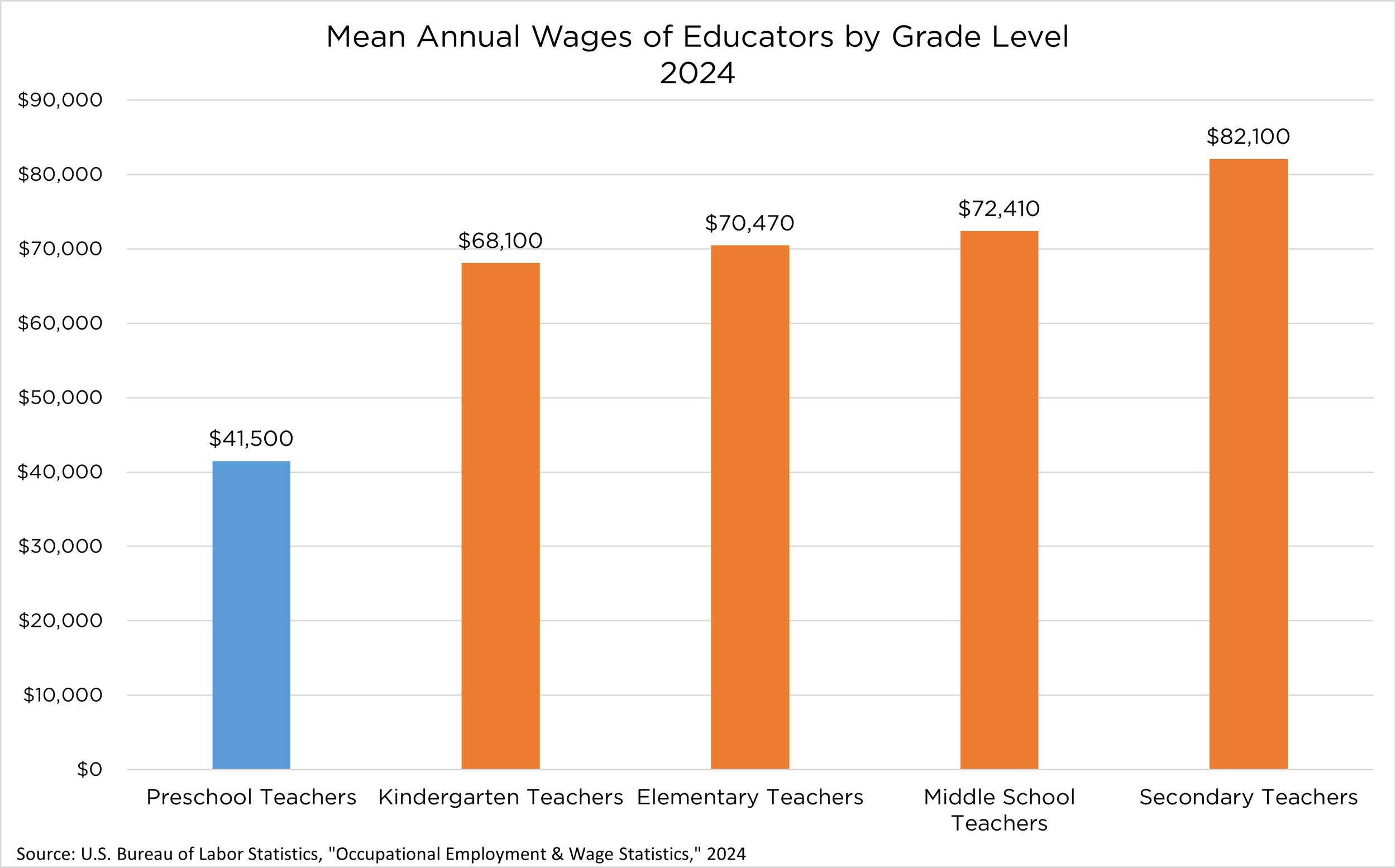
Yet, Illinois faces persistent workforce challenges that indirectly undermine the conditions that best support child development. Early childhood educators are paid significantly less than their K–12 counterparts, with pre-K teachers across settings earning roughly $41,500 annually compared to $68,100 for kindergarten teachers², and non-school based preschool and childcare workers earning still less, $39,000 on average for teachers and as little as $23,000 for assistant teachers.
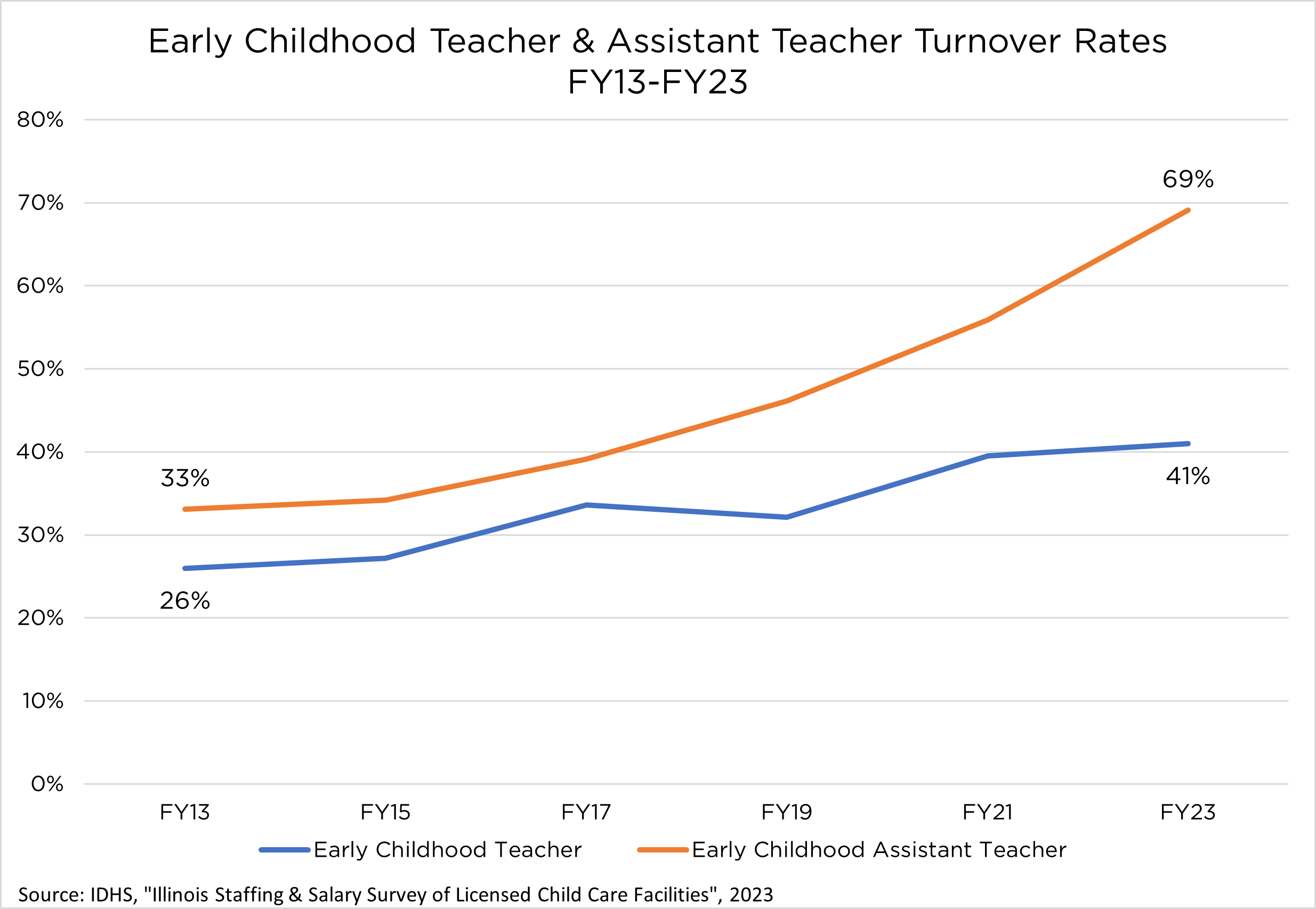
While recent initiatives like Smart Start Workforce Grants are beginning to address compensation, low wages remain a primary driver of high turnover and staffing shortages across the state. Turnover rates³ have risen sharply in recent years, reaching over 40% for teachers and nearly 70% for assistant teachers.⁴ This instability disrupts the consistent relationships children depend on and creates a cycle that ultimately diminishes program quality.
The stakes around a strong early childhood workforce extend far beyond the early years, shaping both immediate and lifelong outcomes for children. Addressing these challenges requires a comprehensive approach that not only raises compensation, but also strengthens professional supports—such as coaching, career pathways, and improved working conditions—to stabilize the workforce and enable educators to deliver the high-quality experiences that are foundational to healthy child development.
Kate Buchanan is the Senior Policy Advisor, Early Childhood for Advance Illinois.
ⁱ Harvard Center on the Developing Child
ⁱⁱHarvard Center on the Developing Child
¹ ISBE, Illinois Report Card, 2024-2025.
² Bureau of Labor Statistics, U.S. Department of Labor, Occupational Employment and Wage Statistics, May 2024. https://www.bls.gov/oes/tables.htm
³ Turnover rates were calculated by comparing the number of staff who left in the past two years to the number of employees currently employed.
⁴ Illinois Department of Human Services, Illinois Salary & Staffing Survey of Licensed Child Care Facilities: FY2023, https://www.dhs.state.il.us/page.aspx?item=163476
Early Childhood and Illinois’ New Single Agency
On May 9, 2024, the Illinois General Assembly passed the historic SB1, creating a single Department of Early Childhood by uniting early childhood services into one new agency. This is an important step in supporting Illinois children and their families with the programs and resources they need to thrive.
Recently, Educator Advisory Council (EAC) members Cara Craig, a Home Visitor with Head Start/ECE Policy at the University of Wisconsin Whitewater/Childcare Network of Evanston, and Michelle Zurita-Sharpe a Pre-Kindergarten Special Education Teacher at Chicago Public Schools discussed their thoughts on the current system and their hopes for the new single agency that SB1 has established.
How would you describe Illinois’ early childhood education and care system before the passage of SB1? How did that system impact your specific work and how have you seen it impact the children and families you serve?
Cara: I have been working in Early Childhood Education (ECE) in Illinois for 25 years. I hope that SB1 brings some form of consistency of quality to programs. ECE has such a strong impact on children and their families, and it is not available for everyone. I recently came from teaching in a private school. We served exclusively affluent families, and these families can always find childcare. I now work for Head Start and the disjointedness of choices and availability is very hard to navigate. Having an umbrella for ECE will hopefully bring things together for families, teachers, centers and ultimately children.
Michelle: Before the passage of SB1, the early childhood education and care system was divided with each agency working to provide similar services in silo. This division created dysfunction in the system for child care providers, families, and workforce members. As someone who went from working in a community-based child care center (CBO) to a public school setting, I experienced firsthand the lack of pay parity that exists for preschool teachers between different settings. I got paid significantly more working in a public-based child care center compared to the CBO despite the fact I followed the same curriculum, had a similar demographic of students, and worked in the same city (a 5-mile difference). In the public school setting, I also worked less hours, had better benefits, and more material support. Contrast to the public school setting, the CBO I worked at had staff that experienced greater financial hardship which contributed to a higher staff turnover rate. The turnover disrupted the educational experiences of children as they were then forced to divide between other classes or tough it out with substitutes that did not know them and their needs. Those of us who stayed were overworked amongst the staffing shortage and could not rely on help from the director, because the director too was overwhelmed navigating the multiple funding streams required to keep the center open and each of the different classrooms in compliance.
What excites you about the move to a unified agency and why? What concerns you?
Cara: I am excited about the positive movement towards the importance of ECE, respect for the people who do the hard work of ECE, the need to make it accessible for all. Not that it needs to be the same, but that families have access to what they need. I am concerned it will become a huge unconnected agency that doesn’t understand what is going on in the real world, losing funding, or taking funding from other important things.
Michelle: I’m excited that the unified agency and Smart Start investments overall will go towards helping child care providers give their staff raises via the Smart Start Workforce Grants and Quality Improvement Grants.
How will the move to a single agency impact young learners, their families, and providers/educators? How will it impact you?
Cara: Hopefully it will bring about an understanding of resources and make them streamlined for families, less confusing and easier to access.
Michelle: This excites me because it is a step in the right direction to retaining current workforce members and hopefully recruiting new ones.
In your opinion, what will ensure that this is a smoother transition for all involved? Are there any key factors the state should take into consideration to improve and strengthen how the system has worked for providers, families and children?
Cara: I think that they need to ensure that they have voices from teachers, and families. Being well-meaning is not enough.
Michelle: To ensure a smooth transition, the state needs to center family and educator voices. Providers and classroom-based staff who work directly with children need to be involved at every step of the process. They have the expertise necessary to make decisions that are not just good for children but best for them.
How will the single agency help your early childhood community?
Cara: Hopefully access to resources.
Michelle: Once programs are unified under the Department of Early Childhood, I would like to see the child care deserts in my community be addressed. Where I live, in Worth, Illinois, there is not enough care available for the number of children under 6 living in the town. This requires families to travel farther away or rely on family members to care for their child while they go to work. The same can be said for surrounding neighborhoods such as Steger, Ford Heights, Justice, Hometown, Lemont, and Chicago Ridge.
New Data Shows Snapshot of Kindergarten Readiness in Illinois
Advance Illinois Senior Policy Advisor Maya Portillo and Start Early Policy Analyst Melissa Maldonado share a snapshot of the steady increases of kindergarten readiness in Illinois, although gaps persist.
The Illinois State Board of Education (ISBE) released its next installation of Kindergarten Individual Development Survey (KIDS) data, providing a snapshot of the skills young children had as they entered kindergarten in the 2022-2023 school year. The COVID-19 pandemic made it difficult to implement the tool and collect the valuable information it provides, but the data the state gathered makes it plain that while COVID-19 disruptions have had an impact, we are heading back to pre-pandemic readiness levels.
As noted in the recent KIDS report, 30% of all students in Illinois demonstrate Kindergarten readiness in all three developmental areas (social and emotional development, language and literacy development, and math), a steady increase that puts the state slightly above pre-pandemic levels. Indeed, since the launch of KIDS in 2017-2018, and despite pandemic challenges, the percentage of students rated “Kindergarten ready” in all three developmental areas has increased by 6 percentage points, reflecting a positive upward trend over time.


While state-wide numbers reflect improvement over time, the percentage of students demonstrating Kindergarten readiness in all three domains varies widely across lines of income, language and learning style. Persistent early gaps between student groups underscore the need for targeted support both during the early years, and in the early primary grades – particularly for students identified as English Learners. Currently implementation challenges exist to assess and identify English Learners but this implementation issue is being addressed by the KIDS Advisory Committee.

Other researchers are beginning to investigate whether and how KIDS relates to later academic performance. A new report from the Illinois Workforce and Education Research Collaborative (IWERC) concludes that KIDS scores are predictive of 3rd grade test scores in Math and English language arts (ELA). Yet, even with similar Kindergarten Readiness scores, Black and Latinx students are less likely to be proficient in 3rd grade math and ELA compared to White students.1
Some of these upward trends are encouraging, but persistent gaps require further work and study in the next few years. To address these gaps, assessment directors and school and district leaders should support administrators and teachers by reducing the amount of costly and redundant kindergarten readiness assessments, promoting the importance of a play-based environment in kindergarten, refering districts to KIDS coaches so they can acquire resources for implementing play-based learning, and ensuring there is an appropriate and full implementation of KIDS. It is too soon to draw any connections or conclusions, but we will note that these recent, modest increases coincide with the first year of Governor Pritzker’s Smart Start IL plan – a multi-year effort to increase funding for early childhood over a period of four years. The administration also plans to create a new Department of Early Childhood, which provides an opportunity for the state to create transformational changes that will benefit the early childhood workforce, young children and their families. This transformational work should be paired with sustainable investments and improved data collection, and we will all be watching to see if these coordinated efforts benefit our youngest learners.
—
1Kiguel, S., Cashdollar, S., & Bates, S. (Forthcoming). Kindergarten readiness in Illinois: Trends and disparities in readiness using the Kindergarten Individual Development Survey (KIDS). Chicago, IL: Illinois Workforce and Education Research Collaborative (IWERC), Discovery Partners Institute, University of Illinois.