


Blog
Our blog provides readers an opportunity to hear from the Advance Illinois staff and partners on education policy issues affecting Illinois students and beyond.
Childcare Remains Unaffordable for Families and Unsustainable for Providers
While Illinois has continued progress in expanding access to early childhood education and care, rising costs and workforce challenges continue to impact families and providers.
This summer, our Childhood Education and Care is Essential campaign will review why high-quality early childhood education and care is essential for a stronger and equitable system. The campaign will discuss workforce compensation, cost of care, equity and access, and the impact on children, families, and communities.
Childcare Remains Unaffordable for Families and Unsustainable for Providers
For Illinois families with young children, childcare has become one of the largest household expenses, competing with housing, food, transportation, and healthcare. According to Child Care Aware of America, the average annual cost of licensed center-based childcare in Illinois can exceed $19,000 for an infant and $14,000 for a preschool-age child. In many communities, the cost of childcare rivals—or exceeds—the cost of housing or public college tuition, placing an enormous strain on family budgets.ⅰ As these costs continue to rise, many families are forced to make difficult decisions about employment, education, and financial stability simply because they cannot afford the childcare they need.
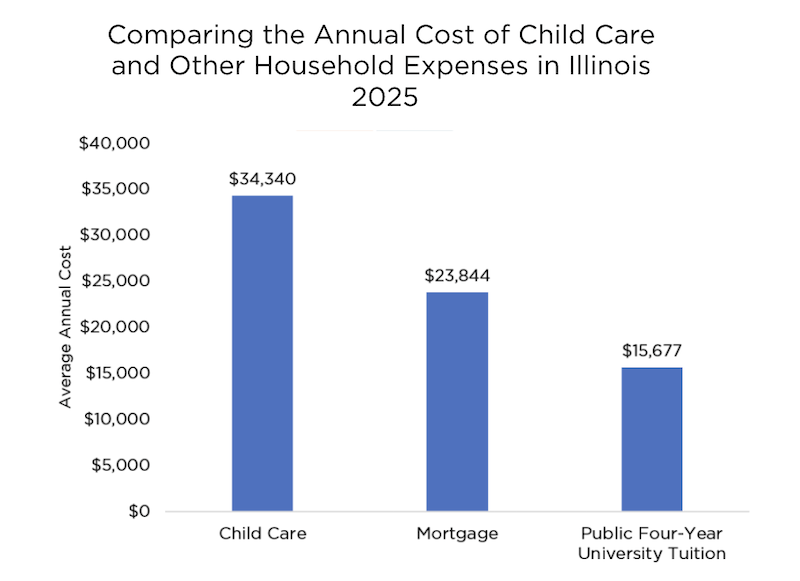
Source: Child Care Aware’s Child Care in America: 2025 Price & Supply Report
Childcare costs in Illinois far exceed the federal standard for affordability – defined as costing no more than 7% of a family's household income. In Illinois, however, the average annual price of center-based infant care consumes 2-7 times that threshold with approximately 14% of the median income for a married-couple family and 48% of the median income for a single-parent family.ⅱ These figures illustrate that, for many Illinois families, the cost of childcare is not simply a budgeting challenge—it is a significant barrier to economic security and workforce participation, even before accounting for the cost of caring for additional children.
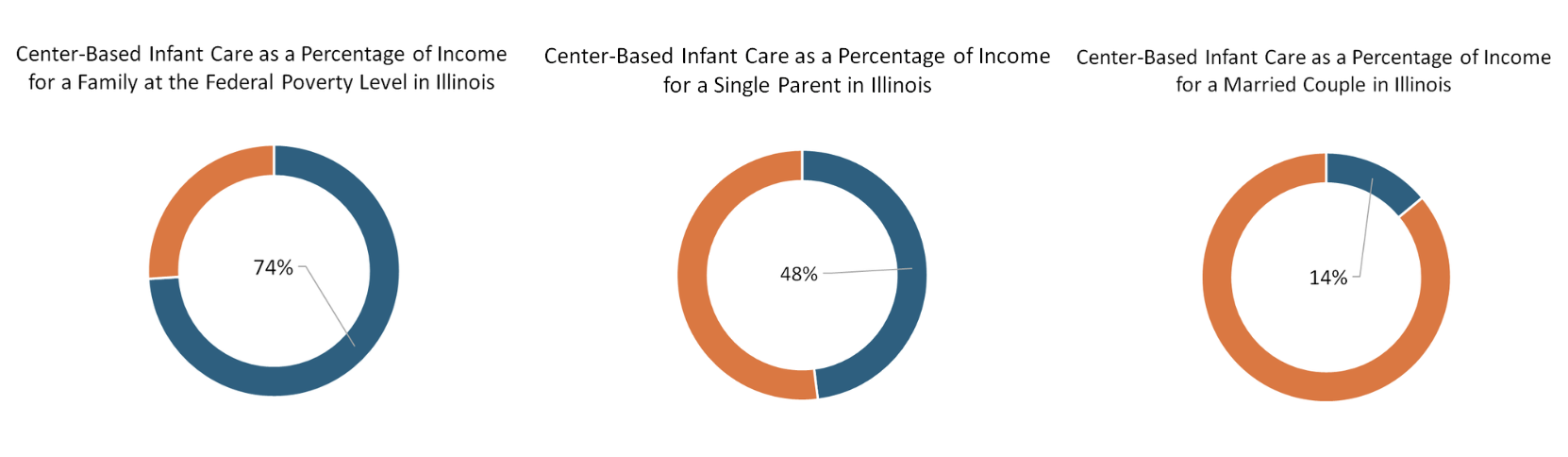
Source: Child Care Aware of America survey (child care prices), U.S. Census Bureau, American Community Survey, Table B19126 (median income)
Meanwhile, providers face rising expenses for educator wages and benefits, facilities, insurance, food, classroom materials, and regulatory compliance. Yet there is little room to increase tuition because many families are already at or beyond what they can reasonably afford. The result is a market-based financing structure that asks families to shoulder costs they cannot sustain while expecting providers to deliver high-quality care with inadequate resources.
While the Illinois' Child Care Assistance Program (CCAP) helps 86,000ⅲ with lower incomes each month afford childcare while they work, attend school, or participate in approved training activities, the subsidy does not always eliminate affordability challenges. Illinois establishes CCAP reimbursement rates using a market rate methodology, which sets maximum payment rates based on prices charged in the childcare market. When a provider's tuition exceeds the state's reimbursement limit, families may be responsible for paying that.ⅳ
This disconnect exists because market prices reflect what families are able to pay—not what it actually costs to provide quality childcare. Childcare is one of the few essential services where the price families can afford to pay is fundamentally disconnected from what it costs to provide quality care. The estimated gap between CCAP reimbursement rates and the true cost of care to provide high-quality ranges from $6,000 for preschoolers to nearly $17,000 for infants.ⅴ The result is a financing system that leaves both families and providers under financial strain.
Illinois cannot solve its childcare affordability challenge by focusing only on families or only on providers. Reducing costs for families without strengthening provider financing risks shrinking the supply of care. Increasing provider resources without improving affordability leaves many families unable to access available programs. Family affordability and provider financial sustainability are two sides of the same equation. Until Illinois closes the gap between what families can afford to pay and what quality childcare actually costs, families will continue to struggle to access childcare, limiting their children's access to high-quality care and early learning opportunities while providers will continue to struggle to provide it.
Kate Buchanan is the Senior Policy Advisor, Early Childhood for Advance Illinois.
Sources
ⅰ. Child Care Aware of America. (2025). Child Care and Early Education Profile: Illinois.
ⅱ. Child Care Aware of America. (2025). Illinois Child Care Affordability Fact Sheet; Child Care Aware of America.
ⅲ. Illinois Department of Human Services Division of Early Childhood, FY25 Illinois Child Care Program Report,https://www.dhs.state.il.us/OneNetLibrary/27897/documents/EC/ADA%20FY25%20Illinois%20Child%20Care%20Program%20Report.pdf?utm_source
ⅳ. Illinois Department of Human Services. 2023 Illinois Child Care Market Rate Survey; Illinois Child Care Assistance Program Policies; 45 C.F.R. § 98.45, Equal Access for Child Care Services. https://www.dhs.state.il.us/OneNetLibrary/27897/documents/MarketRateSurvey/MarketRateSurvey2023_A11Y.pdf
ⅴ. Ritter, K., & Hawley, T. (2021). Cost Model for Early Childhood Education and Care Services. Illinois Governor’s Early Childhood Funding Commission.
The Early Childhood Force Driving Young Children’s Brain Development
Early childhood is a period of extraordinary opportunity and vulnerability, when the brain develops more rapidly than at any other time and lays the foundation for lifelong learning, behavior, and health. This development is driven by the quality of relationships children have with parents and other caregivers through everyday experiences. In that sense, adults who work with children are not just providing care, but actively constructing the developing brain. That is why supporting a highly-trained and stable early childhood workforce is best understood as an investment in young children’s healthy development.
Sadly, despite the critical role played by the early childhood workforce, Illinois, like many other states, faces persistent challenges in attracting and retaining talent. Low wages and scant benefits result in chronic shortages and high turnover rates, which in turn undermine the consistency and quality of interactions that young children need to develop. It is therefore urgent that we align policy and investment with what the science of early brain development tells us.
In the earliest years of life, the brain develops at a remarkable pace, with 90% of brain development occurring before age 5 and neural connections forming more rapidly than at any other time. This development is not automatic; rather, it is driven by children’s experiences, especially the quality of relationships they have with the adults around them that can either support and facilitate a child’s healthy development or stifle it. For example, for very young children, development occurs through “serve-and-return” interactions – the response from caretakers to a young child’s needs, emotions, or behaviors. These interactions quite literally build brain circuitry, shaping children’s language, social-emotional skills, and cognitive capacity. At the same time, early development is highly sensitive to adversity. Prolonged, unbuffered stress—often referred to as “toxic stress”—can disrupt developing brain architecture and have lasting consequences.ⁱ
As many young children spend substantial time in early childhood care and education settings, the quality of care provided plays a critical role in their cognitive growth, language acquisition, and development of social-emotional skills. In these settings, the relationships, interactions, and environments that young children need to thrive rely heavily on the skill and preparation of the adults providing care. High-quality, brain-building interactions require more than good intentions—they call for deep understanding of child development, the knowledge base to create enriching activities and experiences for young children, along with the ability to respond to children’s cues with consistency and intention. Importantly, without adequate training and support, these interactions and experiences can be inconsistent or ineffectual for young children. In this way, workforce preparation directly shapes the extent to which early educators can foster growth across developmental domains and help set young children on a trajectory for kindergarten and later academic success.
In order to effectively support children, promoting growth and kindergarten readiness, the early childhood workforce also needs to be stable. Young children rely on consistent relationships to form secure attachments and feel safe. High turnover—often driven by low pay, burnout, and challenging working conditions—disrupts these critical connections. High staff turnover disrupts the stable, responsive relationships young children need, undermining attachment, increasing stress, and negatively affecting their social-emotional and cognitive development.ⁱⁱ This makes workforce conditions not just an employment issue, but a child development issue. When early childhood educators are well-supported in their work - through stronger compensation as well as ongoing professional development, reflective supervision, and supports that help them manage stress and effectively support children with complex needs, children benefit from the stability and responsiveness those strategies generate.
When early childhood programs deliver high-quality programming, children are better equipped to enter a formal school setting. Unfortunately, gaps in kindergarten readiness continue to persist, with only 21% of children in poverty found to have the foundational skills they need to succeed upon entering kindergarten, compared to the statewide average of 31%.¹ According to the Harvard Center on the Developing Child, high-quality early relationships can buffer the effects of poverty and adversity, helping to close developmental gaps before they widen over time. In this way, investing in the early childhood workforce is not only about improving individual outcomes, but also about creating more equitable trajectories for every child to succeed.
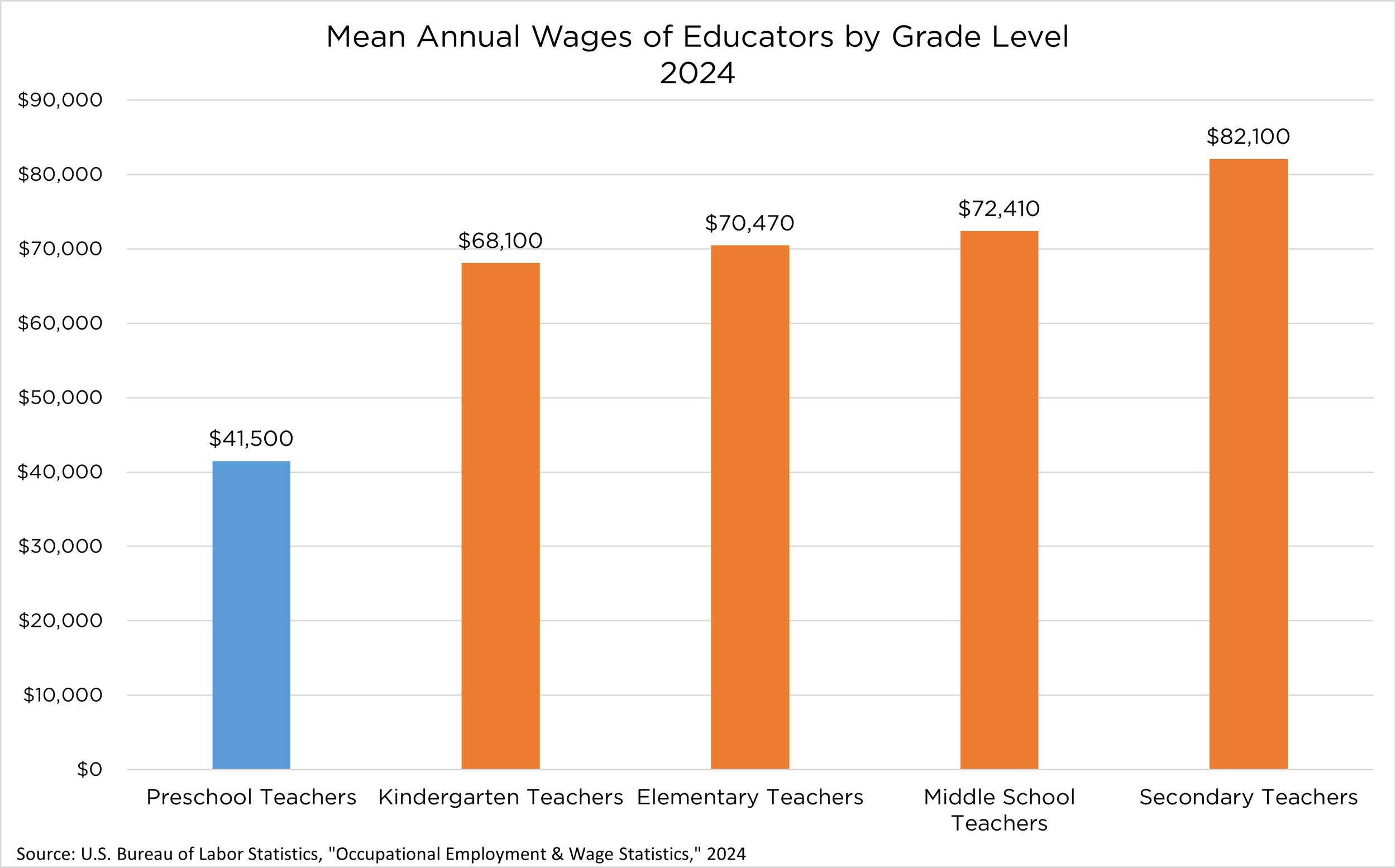
Yet, Illinois faces persistent workforce challenges that indirectly undermine the conditions that best support child development. Early childhood educators are paid significantly less than their K–12 counterparts, with pre-K teachers across settings earning roughly $41,500 annually compared to $68,100 for kindergarten teachers², and non-school based preschool and childcare workers earning still less, $39,000 on average for teachers and as little as $23,000 for assistant teachers.
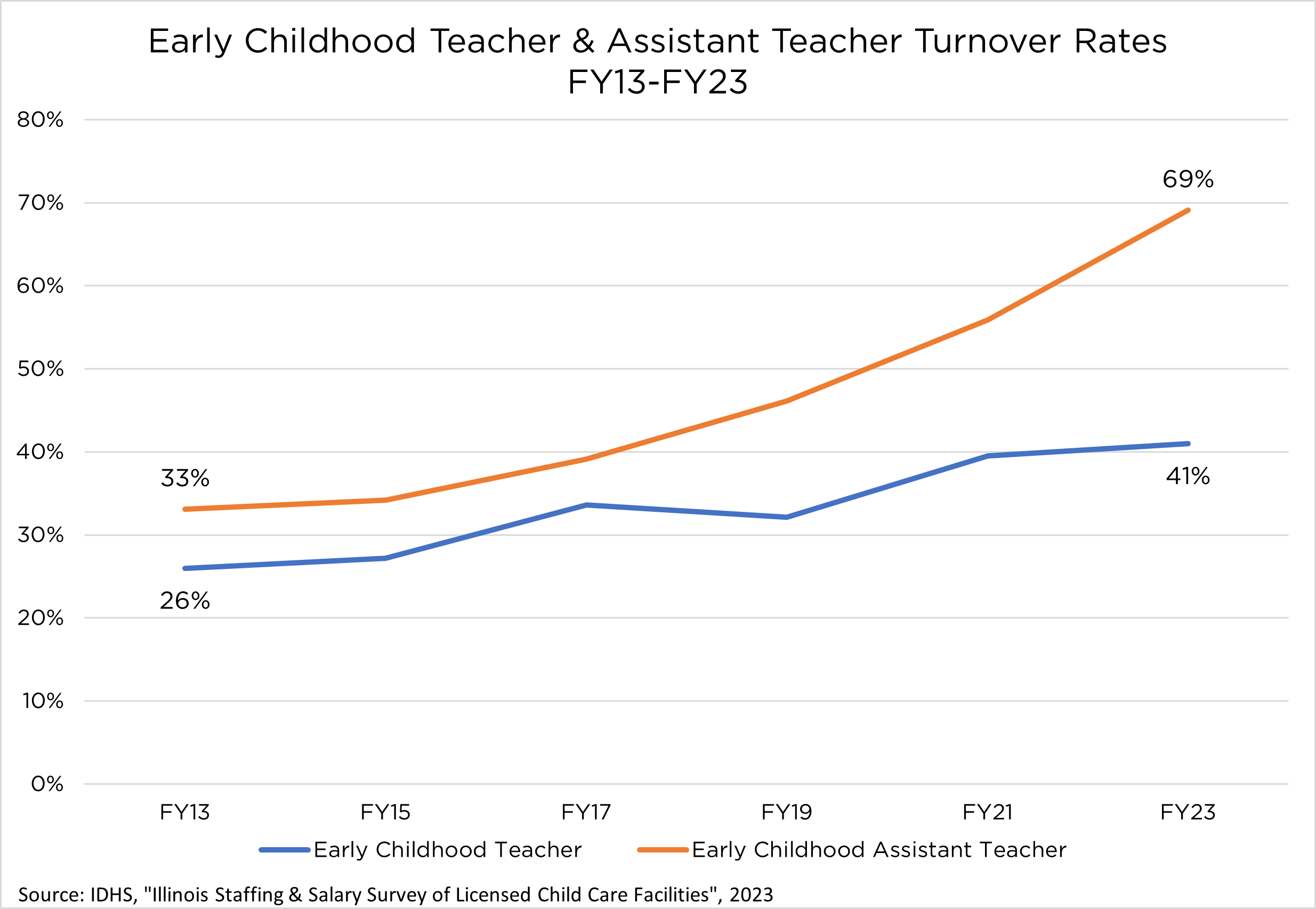
While recent initiatives like Smart Start Workforce Grants are beginning to address compensation, low wages remain a primary driver of high turnover and staffing shortages across the state. Turnover rates³ have risen sharply in recent years, reaching over 40% for teachers and nearly 70% for assistant teachers.⁴ This instability disrupts the consistent relationships children depend on and creates a cycle that ultimately diminishes program quality.
The stakes around a strong early childhood workforce extend far beyond the early years, shaping both immediate and lifelong outcomes for children. Addressing these challenges requires a comprehensive approach that not only raises compensation, but also strengthens professional supports—such as coaching, career pathways, and improved working conditions—to stabilize the workforce and enable educators to deliver the high-quality experiences that are foundational to healthy child development.
Kate Buchanan is the Senior Policy Advisor, Early Childhood for Advance Illinois.
ⁱ Harvard Center on the Developing Child
ⁱⁱHarvard Center on the Developing Child
¹ ISBE, Illinois Report Card, 2024-2025.
² Bureau of Labor Statistics, U.S. Department of Labor, Occupational Employment and Wage Statistics, May 2024. https://www.bls.gov/oes/tables.htm
³ Turnover rates were calculated by comparing the number of staff who left in the past two years to the number of employees currently employed.
⁴ Illinois Department of Human Services, Illinois Salary & Staffing Survey of Licensed Child Care Facilities: FY2023, https://www.dhs.state.il.us/page.aspx?item=163476
Bringing Visibility to the Impacts of Federal Changes on Illinois Education
This month, news dropped that the Illinois Board of Higher Education (IBHE) and at least six universities in our state were suspending a scholarship program that the U.S. Department of Justice called unconstitutional for using race as a qualification.
It was hard to find the name of the program that was suspended – even in the DOJ’s press release – but having confirmed it with a number of credible sources including a program participant, the effort is the Diversifying Higher Education Faculty (DFI) program, an initiative intended to increase the number of minority full-time tenure track faculty and staff at Illinois’ two- and four-year, public and private colleges and universities.
Decades of research show that when educators share racial and ethnic identities with their students, student academic and non academic outcomes improve. At the college level, student and faculty/staff diversity play a considerable role in underrepresented students’ decision to stay in school. But according to IBHE, ‘the average student attending a public college or university outside the City of Chicago is unlikely to have more than one course with an African American faculty member and unlikely to have even one course with a Latino faculty member during his or her college years.’ This mismatch in representation isn’t unique to Illinois, but plays out in communities across our country and stifles what’s possible for our students and those who seek to teach and mentor them.
In an effort to ensure that the many and varied impacts of federal changes on education do not go unnoticed or unheard - like the details of the DFI news slipping between the cracks - we are both listening for and actively gathering narratives from students, families, educators, providers, system leaders, and researchers who are living through the effects of education policy changes on their work and lives. But we need your help.
If you are interested in sharing your story for us to uplift on our blog, on social, and our ever-expanding newsletter list of lawmakers, education, researchers, philanthropists, journalists and more, please complete the form linked below. You may use your real name, a pseudonym, or simply list “anonymous.” We only ask that you provide a valid email address so we can follow up with you.
It is crucial that these experiences are shared so that others may gain awareness and insight into what is happening and how our system, the people who power it, and the people served by it are being affected but also responding to changes.
COMPLETE THE FORM TODAY → https://bit.ly/3REq97H