


Blog
Our blog provides readers an opportunity to hear from the Advance Illinois staff and partners on education policy issues affecting Illinois students and beyond.
The Early Childhood Force Driving Young Children’s Brain Development
Early childhood is a period of extraordinary opportunity and vulnerability, when the brain develops more rapidly than at any other time and lays the foundation for lifelong learning, behavior, and health. This development is driven by the quality of relationships children have with parents and other caregivers through everyday experiences. In that sense, adults who work with children are not just providing care, but actively constructing the developing brain. That is why supporting a highly-trained and stable early childhood workforce is best understood as an investment in young children’s healthy development.
Sadly, despite the critical role played by the early childhood workforce, Illinois, like many other states, faces persistent challenges in attracting and retaining talent. Low wages and scant benefits result in chronic shortages and high turnover rates, which in turn undermine the consistency and quality of interactions that young children need to develop. It is therefore urgent that we align policy and investment with what the science of early brain development tells us.
In the earliest years of life, the brain develops at a remarkable pace, with 90% of brain development occurring before age 5 and neural connections forming more rapidly than at any other time. This development is not automatic; rather, it is driven by children’s experiences, especially the quality of relationships they have with the adults around them that can either support and facilitate a child’s healthy development or stifle it. For example, for very young children, development occurs through “serve-and-return” interactions – the response from caretakers to a young child’s needs, emotions, or behaviors. These interactions quite literally build brain circuitry, shaping children’s language, social-emotional skills, and cognitive capacity. At the same time, early development is highly sensitive to adversity. Prolonged, unbuffered stress—often referred to as “toxic stress”—can disrupt developing brain architecture and have lasting consequences.ⁱ
As many young children spend substantial time in early childhood care and education settings, the quality of care provided plays a critical role in their cognitive growth, language acquisition, and development of social-emotional skills. In these settings, the relationships, interactions, and environments that young children need to thrive rely heavily on the skill and preparation of the adults providing care. High-quality, brain-building interactions require more than good intentions—they call for deep understanding of child development, the knowledge base to create enriching activities and experiences for young children, along with the ability to respond to children’s cues with consistency and intention. Importantly, without adequate training and support, these interactions and experiences can be inconsistent or ineffectual for young children. In this way, workforce preparation directly shapes the extent to which early educators can foster growth across developmental domains and help set young children on a trajectory for kindergarten and later academic success.
In order to effectively support children, promoting growth and kindergarten readiness, the early childhood workforce also needs to be stable. Young children rely on consistent relationships to form secure attachments and feel safe. High turnover—often driven by low pay, burnout, and challenging working conditions—disrupts these critical connections. High staff turnover disrupts the stable, responsive relationships young children need, undermining attachment, increasing stress, and negatively affecting their social-emotional and cognitive development.ⁱⁱ This makes workforce conditions not just an employment issue, but a child development issue. When early childhood educators are well-supported in their work - through stronger compensation as well as ongoing professional development, reflective supervision, and supports that help them manage stress and effectively support children with complex needs, children benefit from the stability and responsiveness those strategies generate.
When early childhood programs deliver high-quality programming, children are better equipped to enter a formal school setting. Unfortunately, gaps in kindergarten readiness continue to persist, with only 21% of children in poverty found to have the foundational skills they need to succeed upon entering kindergarten, compared to the statewide average of 31%.¹ According to the Harvard Center on the Developing Child, high-quality early relationships can buffer the effects of poverty and adversity, helping to close developmental gaps before they widen over time. In this way, investing in the early childhood workforce is not only about improving individual outcomes, but also about creating more equitable trajectories for every child to succeed.
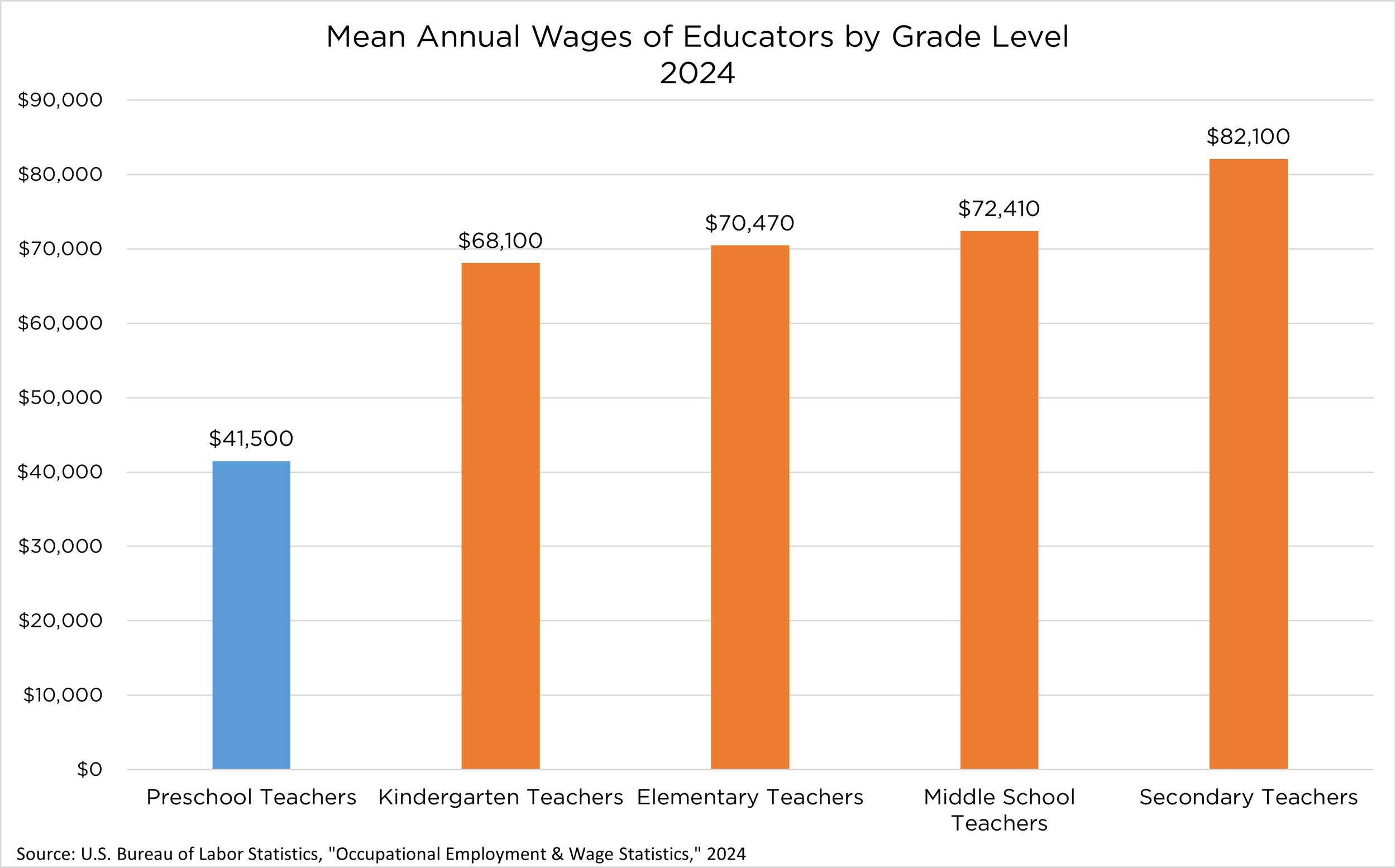
Yet, Illinois faces persistent workforce challenges that indirectly undermine the conditions that best support child development. Early childhood educators are paid significantly less than their K–12 counterparts, with pre-K teachers across settings earning roughly $41,500 annually compared to $68,100 for kindergarten teachers², and non-school based preschool and childcare workers earning still less, $39,000 on average for teachers and as little as $23,000 for assistant teachers.
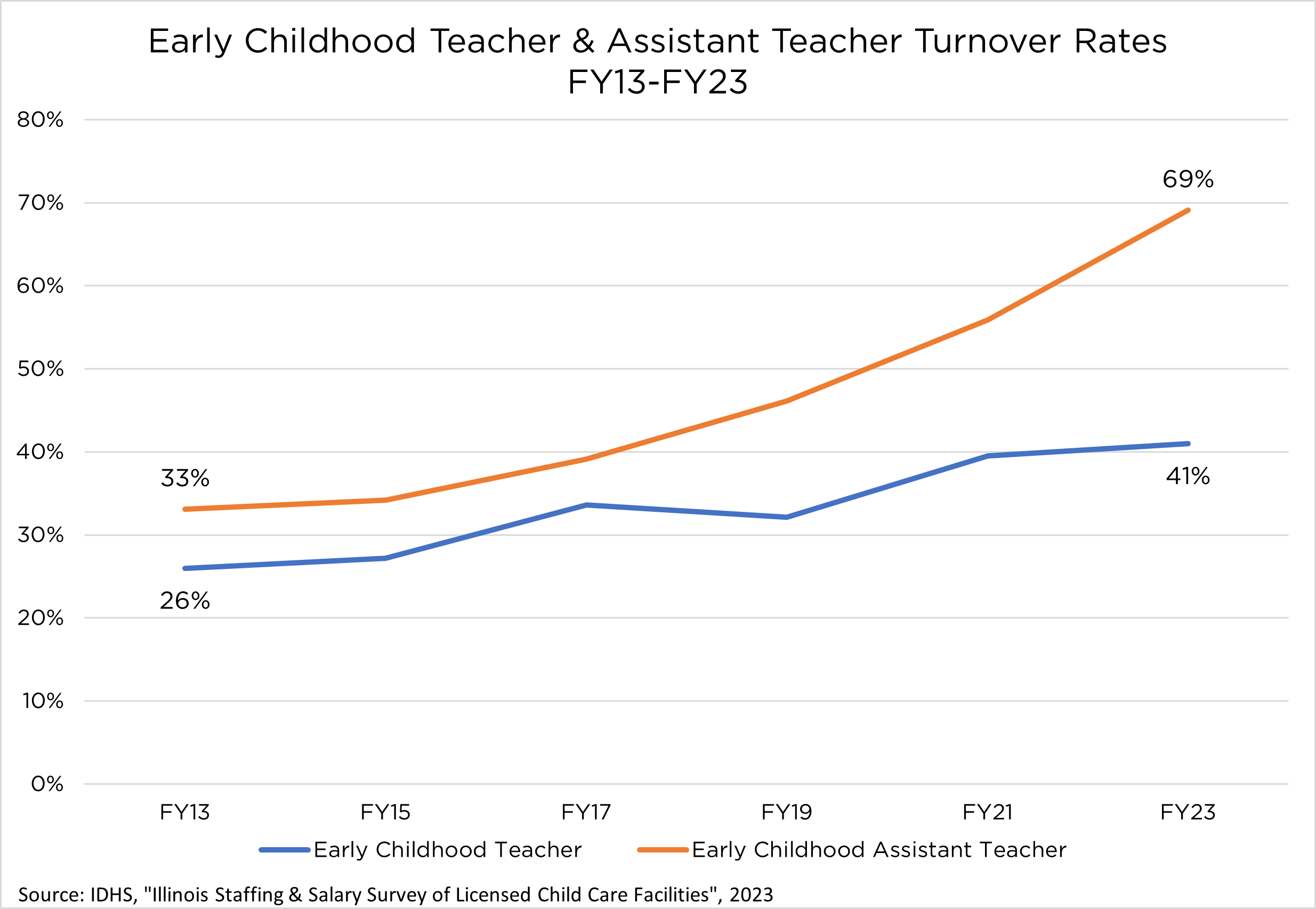
While recent initiatives like Smart Start Workforce Grants are beginning to address compensation, low wages remain a primary driver of high turnover and staffing shortages across the state. Turnover rates³ have risen sharply in recent years, reaching over 40% for teachers and nearly 70% for assistant teachers.⁴ This instability disrupts the consistent relationships children depend on and creates a cycle that ultimately diminishes program quality.
The stakes around a strong early childhood workforce extend far beyond the early years, shaping both immediate and lifelong outcomes for children. Addressing these challenges requires a comprehensive approach that not only raises compensation, but also strengthens professional supports—such as coaching, career pathways, and improved working conditions—to stabilize the workforce and enable educators to deliver the high-quality experiences that are foundational to healthy child development.
Kate Buchanan is the Senior Policy Advisor, Early Childhood for Advance Illinois.
ⁱ Harvard Center on the Developing Child
ⁱⁱHarvard Center on the Developing Child
¹ ISBE, Illinois Report Card, 2024-2025.
² Bureau of Labor Statistics, U.S. Department of Labor, Occupational Employment and Wage Statistics, May 2024. https://www.bls.gov/oes/tables.htm
³ Turnover rates were calculated by comparing the number of staff who left in the past two years to the number of employees currently employed.
⁴ Illinois Department of Human Services, Illinois Salary & Staffing Survey of Licensed Child Care Facilities: FY2023, https://www.dhs.state.il.us/page.aspx?item=163476
Using Data to Better Understand the Educator Workforce
The Illinois State Board of Education’s latest Educator Supply and Demand report extends our understanding of trends in the state’s educator workforce. It reminds us of the fundamental value of collecting and reporting data to surface challenges that exist and help inform efforts to address them.
The Illinois State Board of Education (ISBE) has been sharing a snapshot of the supply, demand, and educator shortages in Illinois for roughly twenty years. This past December, they released their latest version of the triennial Educator and Supply Report, featuring an ambitious and expanded scope. The report analyzes a wide set of metrics, using employment data from teachers, administrators, and support staff.
There’s a great deal to dig into. For my part, having released a report this past fall on how the state has been doing in growing, preparing and retaining its educator workforce, especially amidst COVID, I found certain data points of particular interest. This included updated educator retention data from SY22-23, which suggest that teacher and principal retention has largely returned to pre-pandemic levels after a temporary 'boost' during the early pandemic years (though what these trends look like can depend on how you define ‘retention’). Interestingly, ISBE’s analysis also shows that the number of former educators returning to the profession, which decreased in the first year of the pandemic, still hasn’t bounced back.
While these overall numbers are important, anyone who lives in Illinois knows that there are significant differences in educator supply and demand across communities and schools throughout the state. The most recent report embraces this geographic diversity, demonstrating how retention varies from region to region.
There are real regional disparities across certain metrics. Yet ISBE’s analysis also makes clear that some challenges are consistent across the state. While the racial composition of public school students varies from place to place, every region in the state sees a profound gap between the percentage of students of color and percentage of teachers of color. It is both intuitive and substantially research-backed that a racially and ethnically diverse teacher workforce matters. Still, no matter where in Illinois you look, you’ll see a workforce that is far from representative of local students.
Finally, the report reminds us that reality does not always reflect our expectations. For example, we know that there is high demand for bilingual and foreign language teachers. That said, data from the last three years show that rates at which completers of educator preparation programs were hired into Illinois public schools within one year of completion were lower for educators with bilingual and foreign language endorsements compared to educators endorsed in most other areas.
To me, this exemplifies why reports—and data—like this matter; our assumptions about trends and challenges may not align with reality. On its own, data cannot fix what ails Illinois’ educator workforce. But it’s a critical tool for understanding where the real challenges actually are, how they manifest, and what it will take to address them. If we don’t accurately understand the problem, we may propose or invest in misguided solutions. ISBE’s report, in combination with other recent or upcoming research and analyses, is not only illuminating and important, but should help guide efforts to build out and support the educator workforce this coming legislative session and beyond.
Mercedes Wentworth-Nice is a Senior Policy Associate for Advance Illinois.