


From the Desk
Our From the Desk publications serve as an avenue for us to discuss in-depth education policy issues that we support.
From the Desk—EBF Has Been Transforming What Our Schools Can Do for Illinois Students. Now What?
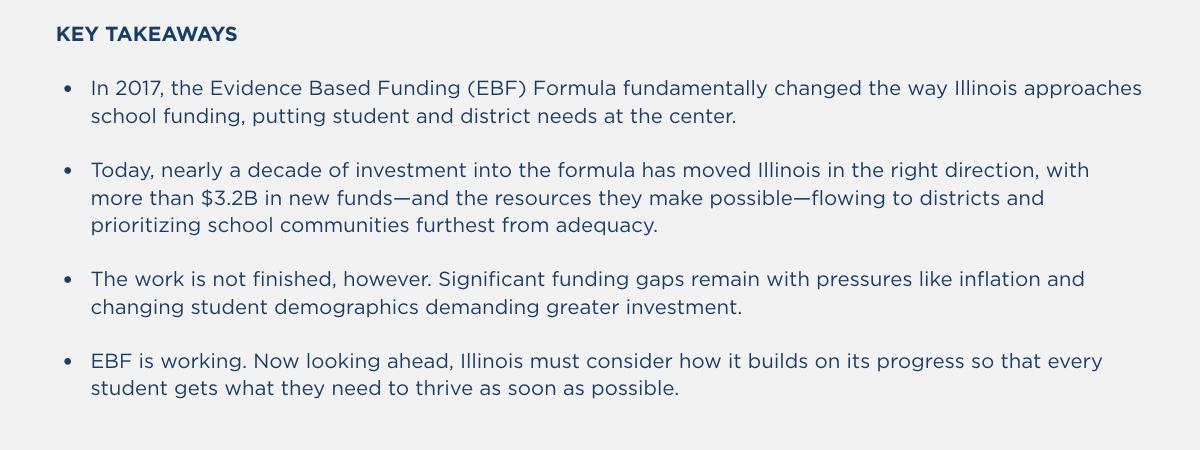
2027 will mark the 10th anniversary of Illinois' bold move to transform the way in which it funds public schools. It is a transformation Advance Illinois helped lead and champion with partners from every corner of the state, and it stands out as one of the most significant policy reforms the state has undertaken in recent memory. Like many of you, heading into this anniversary, I find myself wanting to celebrate, wanting to understand what impact our new formula has had on students and schools, and also wanting to think about the work ahead. I will not cover all of that ground today (watch for in-depth reports on EBF's impact over the course of the coming year), but I'd like to begin what I hope will be a statewide conversation.
Why EBF Was Necessary
Years ago, when conversations around EBF began, the state’s outdated school funding approach placed it 47th in the nation for funding equity – that is, the gap in per pupil spending between low and high poverty districts— and 24th in terms of state share of school funding. Worse still, budget shortfalls meant that even our deeply inadequate state-level foundation funding was being prorated (i.e., districts were only getting a portion of what they’d been promised). Put simply, the system was deeply underfunded and deeply inequitable – both because over-reliance on property taxes meant wildly different resources were available at the local level, and because the majority of state dollars were being spent without regard to local need. The result? Student learning and opportunity depended dishearteningly on zip code.
At the same time, more was being asked of teachers and leaders to help students meet higher standards. This was right and proper, but if we wanted teachers and principals to succeed, they needed the resources required to serve their students well.
For years, the fight was simply to get more money into the system – a system that assumed funding needs were largely the same across districts. But those efforts, while well-intentioned, were inherently inefficient. Why? Because while $10,000 per student might be enough for one district, it might be less than half of what students in another district need to succeed. Without a method for understanding and prioritizing student need across and among districts, Illinois would have to spend dramatically more money than was actually necessary to ensure all students thrived. All this at a time when the state faced serious budget shortfalls, and many schools and districts were cutting every possible corner to make ends meet:
“Prior to the passage of the Evidence-Based Funding model, there was one computer cart that had to be shared between six different grade levels. Since its passage, we are now able to ensure that every student has access to computer technology, including access to a device whenever they need it.
—Dr. Shane Gordon, Bluford USD #318, Celebrating Five Years of Evidence-Based Funding Formula Success, A Superintendent’s Perspective, 8/31/22
“I remember a different time when my district had just 23 days cash on hand, General State Aid had stopped flowing, and districts like ours were faced with the decision to make catastrophic cuts to personnel and programs or close our doors.”
—Dr. Jill Griffin, Bethalto School District #8, ISBE Hearing Testimony, 10/5/2023
How EBF Changed the Game
EBF (SB1) became law in 2017 with bipartisan support, replacing our worst-in-the-nation model with a formula that takes into account student need as well as available local resources. This new approach allowed state and local leaders to, for the first time, understand what each individual district needed to ensure every student thrives – and how far each was from that "adequacy target." That is powerful information, and it allows the state to do something it couldn't do before: target new dollars to support those districts furthest from adequacy, without harming districts with access to more local resources through property taxes. It also shed a light on the very different realities districts were facing across the state. Some were operating well above adequacy (generally due to high property values), while others had dramatically less than they needed. And those high-need districts were rural and urban, large and small, in red counties and blue counties. Moreover, once we all saw and understood the depth and breadth of need, and had a way to understand the deep disparities – not at a conceptual level, but on a district-by-district basis – it was hard to unsee. A powerful coalition came together to push for change (Funding Illinois' Future), and the General Assembly acted.
Importantly, because the formula is dynamic, it ensures that new dollars continue to flow most heavily to students and schools with greatest need. The formula takes into account changing enrollment, changing student demographics, and changing local funding capacity. As importantly, new funds are distributed through a 4-tier system, with 99% of new funds going to schools under 90% of adequacy, and with dollars flowing disproportionately to the students and districts that need them most. That said, EBF also includes a "base funding minimum," so districts never receive less in state funding than they did the year before. Taken together, these features allow high-need districts to "catch up", while ensuring year-to-year funding stability that allows all districts to plan ahead. No wonder it has become a national model!
In addition to adopting EBF, the General Assembly committed to investing $350M new dollars each year to get schools to full funding and to help districts lower local property taxes. Importantly, with the exception of one year (at the start of COVID), they have done just that. The result? Today, more than $3.2 billion in new funds are flowing to districts, thanks to EBF. That's huge! It may be the single most significant and steady funding growth Illinois schools have ever experienced, and it is why Illinois jumped from 47th to 18th in per student funding by 2023.
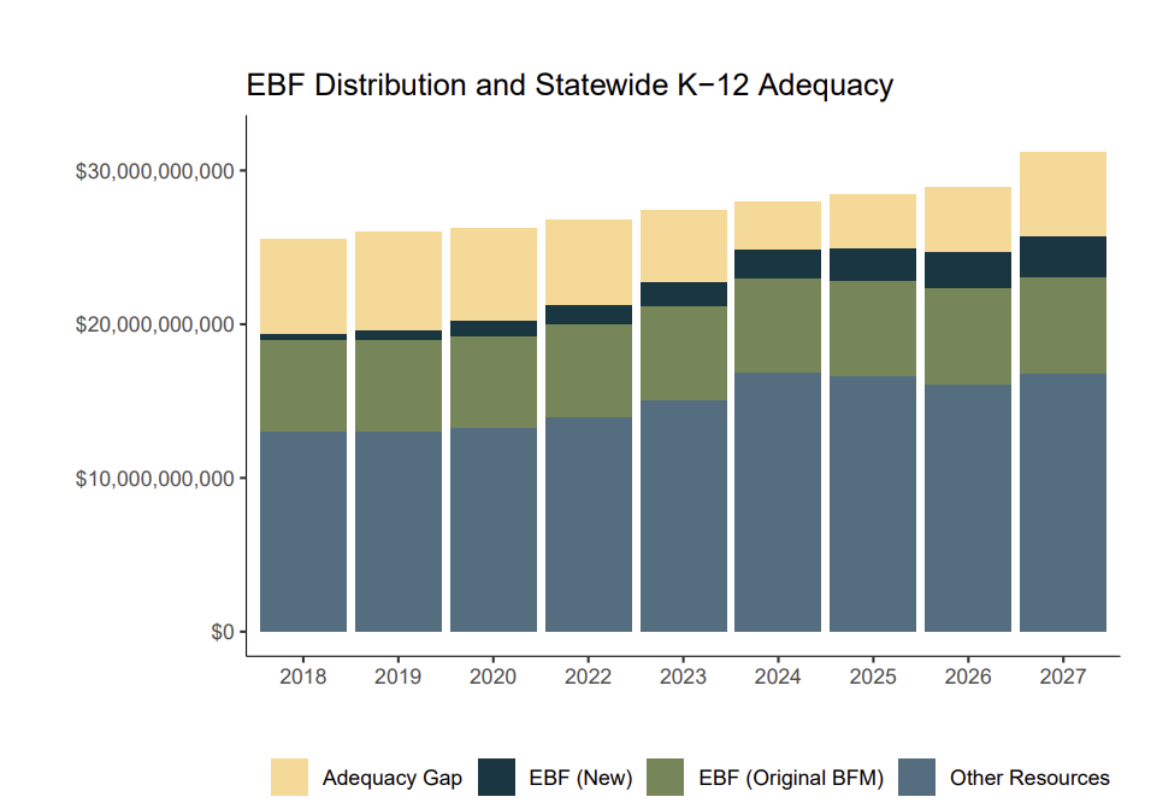
As the formula responds to the changing circumstances of the state—both around cost and changing student needs—our statewide adequacy gap (yellow bar) has changed over time. In FY2024, Illinois saw a significant rise in revenues coming from local sources (largely CPPRT) which meant that many districts were temporarily closer to adequacy. New investments through EBF (navy) have gone into the formula consistently and substantially over this time period.
EBF's Impact Has Been Profound
What has been the impact? The formula has reduced the number of severely underfunded districts (those receiving less than 60 percent of the resources they need) from 168 districts in 2017 to 0 in 2026. It has supported the hiring of more new teachers and counselors, especially for low-income schools and students with special needs. Indeed, EBF has helped lower student teacher ratios: from 15.2:1 in 2009 to 13.2:1 in 2024.
“EBF has directly impacted our ability to invest in curricular resources, provide the staffing we need to meet the diverse needs of our students, and address the much-needed improvements in the learning environments we create for our students. Additionally, because of the investment we have been able to make in our teachers, our retention rate has grown by 5% since 2017 and that makes a significant difference for our students, our families, and the entire community.”
—Dr. Mary Havis, Berwyn South School District 100, Illinois Superintendent Summer Spotlight Series, 2023
“I can say with confidence that without additional dollars invested into Evidence Based Funding my school district will eventually be forced into deficit spending.”
—Ed Fletcher, Monmouth-Roseville School District #238, EBF Advocacy Day Rally 2024
“We have been able to reintroduce elementary physical education, a full-time art teacher, K-12 music classes, and add a social worker. It had been expected of teachers to figure out how to successfully weave these aspects into their lesson planning, but it is no longer necessary.”
—Dr. Shane Gordon, Bluford USD #318, Celebrating Five Years of Evidence-Based Funding Formula Success, A Superintendent’s Perspective, 8/31/22
Put simply, EBF has empowered Illinois school districts to serve their students better.
Thanks to EBF, more resources – like teachers, reading specialists, counselors, afterschool programs, up-to-date curriculum and materials – are available and helping students (and communities) succeed.
Our educational system will sustain our economic growth! These two important items, education, and economic growth, must be on parallel tracks. When and if they don’t match it is hard to run a train successfully down those unmatched tracks
—Dr. Joshua Stafford, Vienna High School District, ISBE Budget Hearing 10/28/2024
But the Work isn’t Finished!
Amid the well-deserved celebration of EBF’s progress, there is urgent work still to do. While the formula has dramatically reduced the number of severely underfunded districts, the statewide adequacy gap remains greater than $3 billion, and three out of four Illinois students still attend school in districts that are not adequately funded.
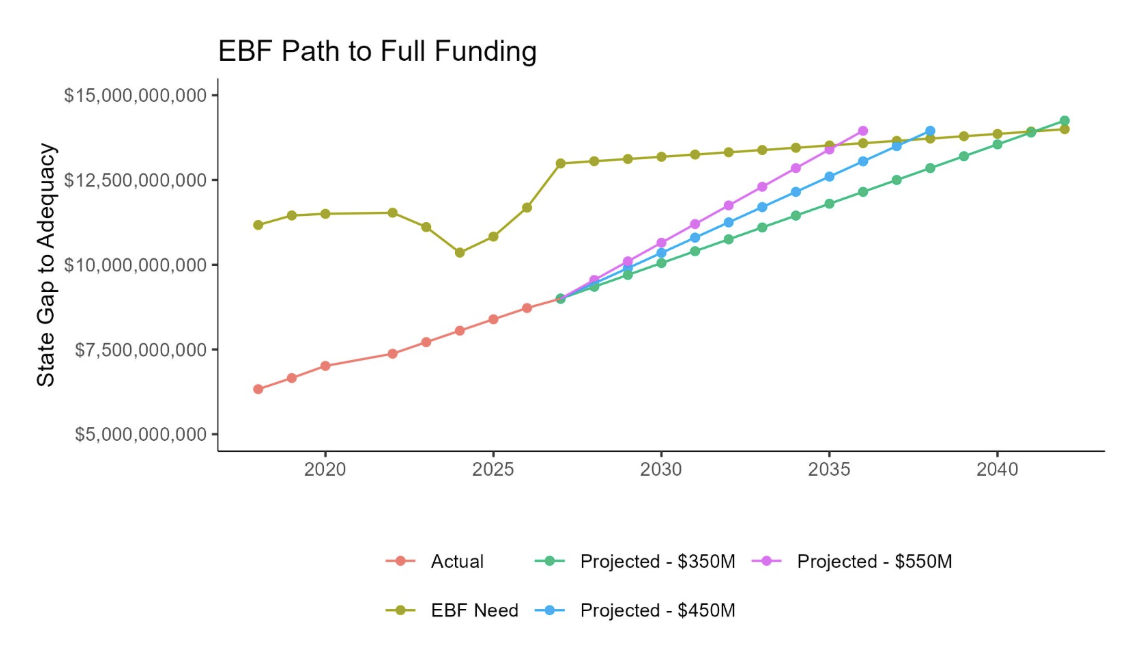
Recent data from ISBE highlight that while the formula continues to successfully increase investments in every district and does so with an equity lens, continued investment at the minimum level of $350M will not keep pace with inflationary pressures and changing student need. On top of that, the (1) drop in CPPRT revenues (corporate and personal property replacement tax) after a 2024 high point and (2) sunset of ESSER dollars left major budgetary gaps in their wake, causing Illinois' overall level of funding adequacy to sag backwards as those revenues declined. As the following chart shows, while progress is being made, increased annual investment is needed to keep districts on track to adequacy and get them there faster.
In Conclusion...
Ten years ago, Illinois lawmakers made a bold decision to create a lifeline for schools and communities across the state. And to their credit, they have remained committed. THANK YOU!
Now, as we approach EBF's 10th anniversary, it is appropriate for state and local leaders to discuss whether there are changes that will help this powerful formula work even more effectively. For our part, we believe thoughtful review is appropriate, and will be sharing ideas over the coming year. In the meantime, let us celebrate the transformative impact EBF has spurred and recommit to a system that identifies local need, efficiently and effectively meets that need, and benefits every Illinois student.
From the Desk— Remembering Governor Edgar, A Powerful Illinois Leader
In addition to serving Illinois as a principled, compassionate elected official, Gov. Jim Edgar served as Founding Co-Chair and champion of Advance Illinois and the bipartisan work it represents to strengthen educational opportunities and outcomes for Illinois students.
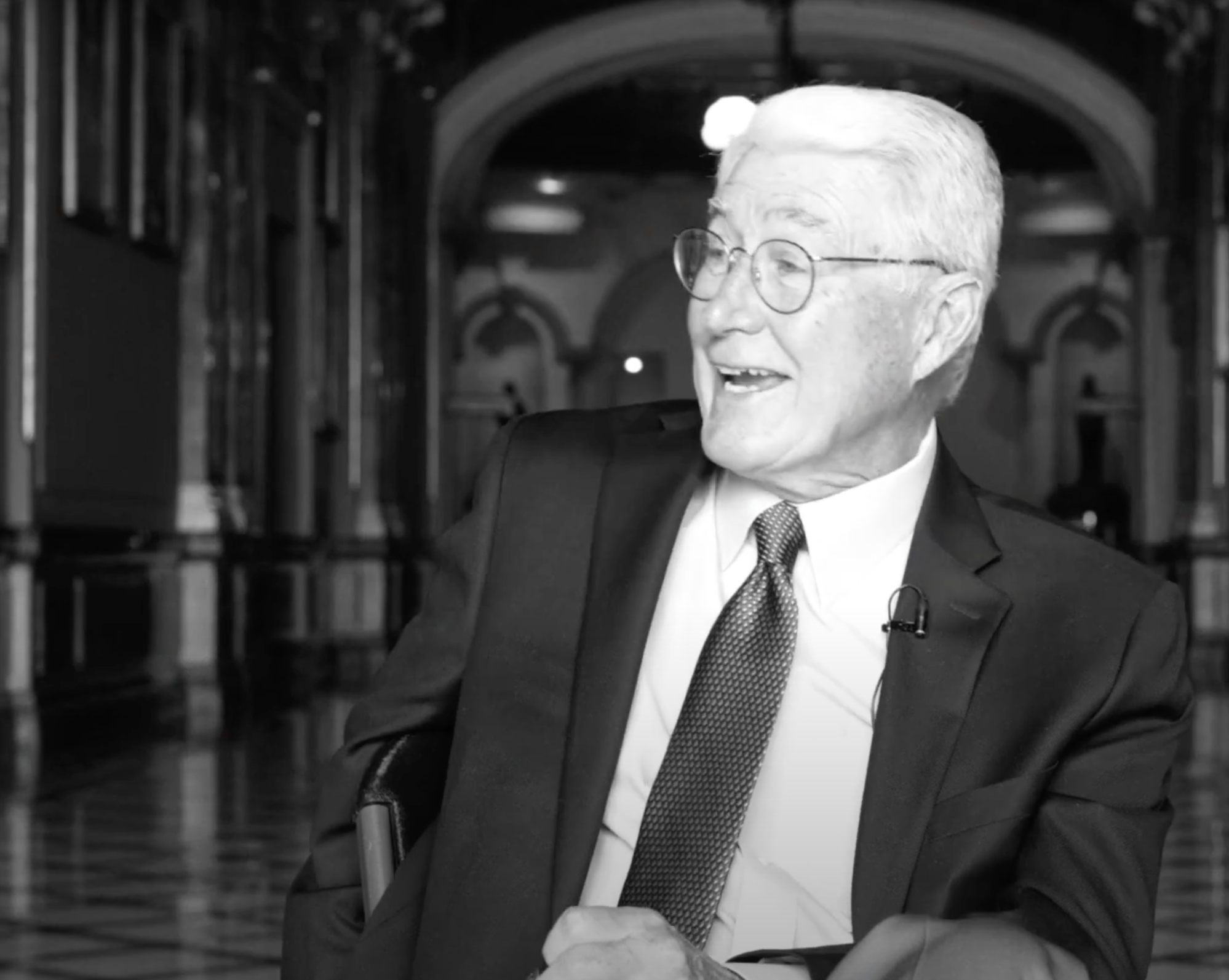
Gov. Jim Edgar, Advance Illinois Founding Co-Chair.
It is with heavy hearts that we write to honor the passing of former Governor Jim Edgar. At a time when political strife is on the rise, Illinois has lost a public servant who believed in public service and in using elective office to bring people together to improve the lives of all families. It is not surprising that Gov. Edgar remains one of the most beloved former governors in the state, or that he leaves a tangible, bipartisan legacy.
While in office, Gov. Edgar tackled thorny issues ranging from ballooning pension debt, and state deficits, to inequitable school funding, and did so while retaining broad-based support. After stepping down as Governor, Jim Edgar resisted calls to run for other offices, choosing instead to speak candidly about political issues and races, and to focus on mentoring the next generation.
In that vein, Gov. Edgar lent his considerable reputation and energy to founding two bipartisan organizations. First, he joined a group of civic leaders who came together to investigate whether and how Illinois could make more significant progress ensuring that every Illinois student had the education they needed to thrive and succeed. The group concluded that Illinois would benefit from an organization that worked on systemic issues and did so across traditional geographic, political, and other divides. Gov. Jim Edgar believed enough in the mission that he agreed to become founding co-chair of Advance Illinois. Partnering with Bill Daley, a well-known Chicago Democrat, Gov. Edgar lent his voice to establishing Advance Illinois as a credible, bipartisan organization committed to using data and research to identify high-impact strategies, and to working across the diversity of Illinois to engage and involve stakeholders.
Several years later, in a similar vein, Gov. Edgar founded the Edgar Fellows Program at the University of Illinois. The program has a simple, but important, goal: to bring the next generation of state leaders together to learn from and with each other about the issues the state faces. Explicitly, the goal was to ensure that every cohort of Edgar Fellows represented the political, geographic, gender, racial, and civic diversity of the state – with a special emphasis on leaders in or likely to pursue elected office. From there, the objective was for Fellows to get to know each other – well enough to work across divides on hard issues. The program boasts over 500 graduates and continues today.

Advance Illinois 15th Anniversary honorees former White House Chief of Staff Bill Daley, former Governor Jim Edgar, and former Illinois State Senator Miguel Del Valle with Advance Illinois President Robin Steans. (November 1, 2023)
As anyone who had the pleasure of working with him will attest, in addition to being a laudable public figure, Jim Edgar was just a wonderful human being. He was unfailingly candid, perceptive, engaging, and warm. At one of his final public appearances, he used his time to lament the importance – and absence – of compassion as a driving force in government. And that basic humanity was just as present up close. It will forever be a personal and professional highlight to have had the opportunity to work closely with Gov. Edgar in launching Advance Illinois. He spent untold hours with me discussing issues of the day, strategizing, or just reflecting on the world – hours filled with real interest in advancing good policy, a keen and self-deprecating sense of humor, and a genuine desire to support others to learn and grow. Jim Edgar cared deeply about Illinois and dedicated himself to finding ways to support its ongoing growth and health – through public service, through education, and through supporting the next generation of leaders.
I know we are not alone in mourning the loss of Governor Edgar. We join an extensive cross-section of the state in sending our condolences to his family and celebrating his legacy. We are grateful for who Gov. Edgar was, and, in turn, what he meant to our organization. Like others, we are committed to carrying on his legacy; to reach across divides to make great things happen for every child and student in our state.