
From the Desk
Our From the Desk publications serve as an avenue for us to discuss in-depth education policy issues that we support.
From the Desk—In the Face of Uncertainty, Working Together for Illinois Students and Children
I struggled with how to begin this end-of-year reflection. Like most of you, I am looking forward to taking time with my family as we celebrate the holidays and look ahead to a New Year. But it is hard to know quite what to say about a year that contained such unprecedented change and uncertainty, let alone one that included so much hardship and that is closing with such tragic headlines.
Months of federal actions are changing the landscape of public education. While certainly there was (and remains) room to improve the way in which we operate sprawling and significant federal programs, most changes go far beyond reform. Instead, many undermine decades of hard-won work to safeguard, improve, and expand access to opportunities for millions of children and students in this country who rely on our public schools, as well as programs that ensure families have food and medical care. And while a new administration inevitably brings with it changes in funding priorities, there are forward-looking processes for that change – ones that allow programs and their participants to plan and adjust without causing disruption and harm. In a departure from all norms and legalities, that is not what happened this year.
2025 has brought with it:
Vigorous executive branch efforts to dismantle the Department of Education, notably by dramatic reductions in staff that are causing delays in critical payments and programs, and with an outsized impact on data collection, civil rights enforcement, special education and federal student financial aid programs.
Cancellation or pausing of nearly $900M in research contracts that weaken stakeholder ability to make informed decisions to strengthen practice and policy and, by extension, student achievement.
Punitive demands on institutions of higher education, with critical federal funding threatened or withheld to ensure compliance with demands that exceed (and in some cases pervert) civil rights laws.
Funding that was by turn frozen (then released), rescinded, or delayed – often with little or no notice or process, and outside the normal budgeting process.
Deployment of immigration enforcement officials (and those hastily deputized) to conduct aggressive operations in Illinois and elsewhere that produced little success, by the agency’s own objectives, but sowed fear and loss in communities that spread far beyond the immigrant communities it targeted.
I could go on.
Instead, I will turn to the positive. Despite the issues generated by federal upheaval, Illinois accomplished some important work for children and students:
Protecting Public Spaces of Learning and Care
In the face of aggressive immigration and law enforcement efforts led by the federal administration in states across the country, including our own, the General Assembly passed, and Gov. Pritzker signed, a series of state laws aimed at protecting immigrant and newcomer children, students, and families in public education settings from unlawful immigration enforcement activities. The Safe Schools for All Act (HB3247) codified constitutional law and protects the rights of all students to access public k-12 education regardless of their immigration status. Among other things, the law prohibits schools and districts from disclosing or threatening to disclose the actual or perceived immigration status of students or their caregivers. Further, HB1312, passed in veto session, places similar restrictions on child care staff as well as public colleges and universities, both of which will be prohibited from disclosing citizenship information about students or employees. Children cannot be expected to learn– let alone attend school - if they do not feel safe. Districts including Chicago Public Schools have in fact reported concerning drops in attendance amid ICE raids in the Chicago area, so we applaud lead bill sponsor State Senator Karina Villa and the Latino Policy Forum, Illinois Coalition for Immigrant and Refugee Rights (ICIRR), Mexican American Legal Defense and Educational Fund (MALDEF), The Network: Advocating Against Domestic Violence, Legal Action Chicago, the Law Office of the Cook County Public Defender, Start Early, Illinois Action for Children, and many other advocates for championing this important legislation that enshrines Illinois’ protection for every child and student and their family to learn without fear.
Supporting Student Well-being and Mental Health
As our own State We’re In: 2025 reveals, mental health issues continue to impact student achievement. Chronic absenteeism here and nationally remains at worrisome and high levels, and students continue to report elevated levels of depression and suicidal thoughts. Appropriately, the state advanced efforts to understand and support child well-being and mental health, which are fundamental to learning and growth. Among other things, ISBE released the Children’s Adversity Index in June, which identifies where and to what degree community level trauma is present across the state, putting powerful data into the hands of advocates and lawmakers alike to expand and target resources to foster safer, healthier school communities. In addition, during this past legislative session, state lawmakers passed SB1560 requiring all schools to offer voluntary mental health screenings to students enrolled in grades 3 through 12, at least once a year, beginning with 2027-2028 school year. And to address ongoing attendance issues (which remain one of the most powerful indicators of academic success), the General Assembly created a Chronic Absence Task Force to develop recommendations and report on progress. Finally, at the collegiate level, HB3385 requires all institutions to provide licensed clinical counselors, social workers, or other mental health professionals on campus. With more tools capturing greater insight into student mental health and community conditions, and more mental health personnel being deployed on college campuses, Illinois is setting the stage for healthier schools and more data-driven decision making to sustain them.
Establishing Key Systems for Transparency and Accountability
This year, the state was successful in paving a path for more data-driven decision- making, and greater equity and access at both the early childhood and postsecondary levels. SB0406 creates a new Early Childhood Integrated Data System (ECIDS) to collect, integrate, store and report on early childhood data across programs and agencies. While it will take time for ECIDS to be up and running, it is badly overdue and will help anchor critical work going forward allowing the agency to develop tools for parents and communities to access aggregated data On the other end of the education spectrum, SB2039 calls for a new public-facing and centralized higher education dashboard to report on everything from institutional affordability to student enrollment, persistence, and completion, starting in 2027. These developments strengthen the state’s education data infrastructure and transparency, and they could not come at a more urgent time, as federal actions have slashed data and research support and infrastructure.
Making sure that all children have what they need to live up to their full potential remains one of the most important responsibilities we all have. It is both the right thing to do, and it is the surest way to strengthen the future for all of us. The United States was among the first in the world to recognize the importance of educating every young person and to invest (however imperfectly) in public education for all. Leaders of every political stripe have understood and championed the value of strong public schools, not just to ensure economic and political vitality, but to forge civic and community relationships. And Americans from every corner of the country have consistently reaffirmed the value of meeting children where they are.
As we head into 2026, I hope that these strong and common values will ensure that we continue to not only invest in the next generation, but that we do so with the understanding that we all benefit when everyone has the chance to learn and grow.
So let us recommit ourselves to focusing on the next generation; on what they need to succeed. And let us take time this holiday season to appreciate those who support our young people in classrooms and childcare centers and college campuses. Let us rest and rejuvenate with family and friends…then come back together to make a positive difference in the New Year.
Warmly,
Robin
From the Desk— Remembering Governor Edgar, A Powerful Illinois Leader
In addition to serving Illinois as a principled, compassionate elected official, Gov. Jim Edgar served as Founding Co-Chair and champion of Advance Illinois and the bipartisan work it represents to strengthen educational opportunities and outcomes for Illinois students.
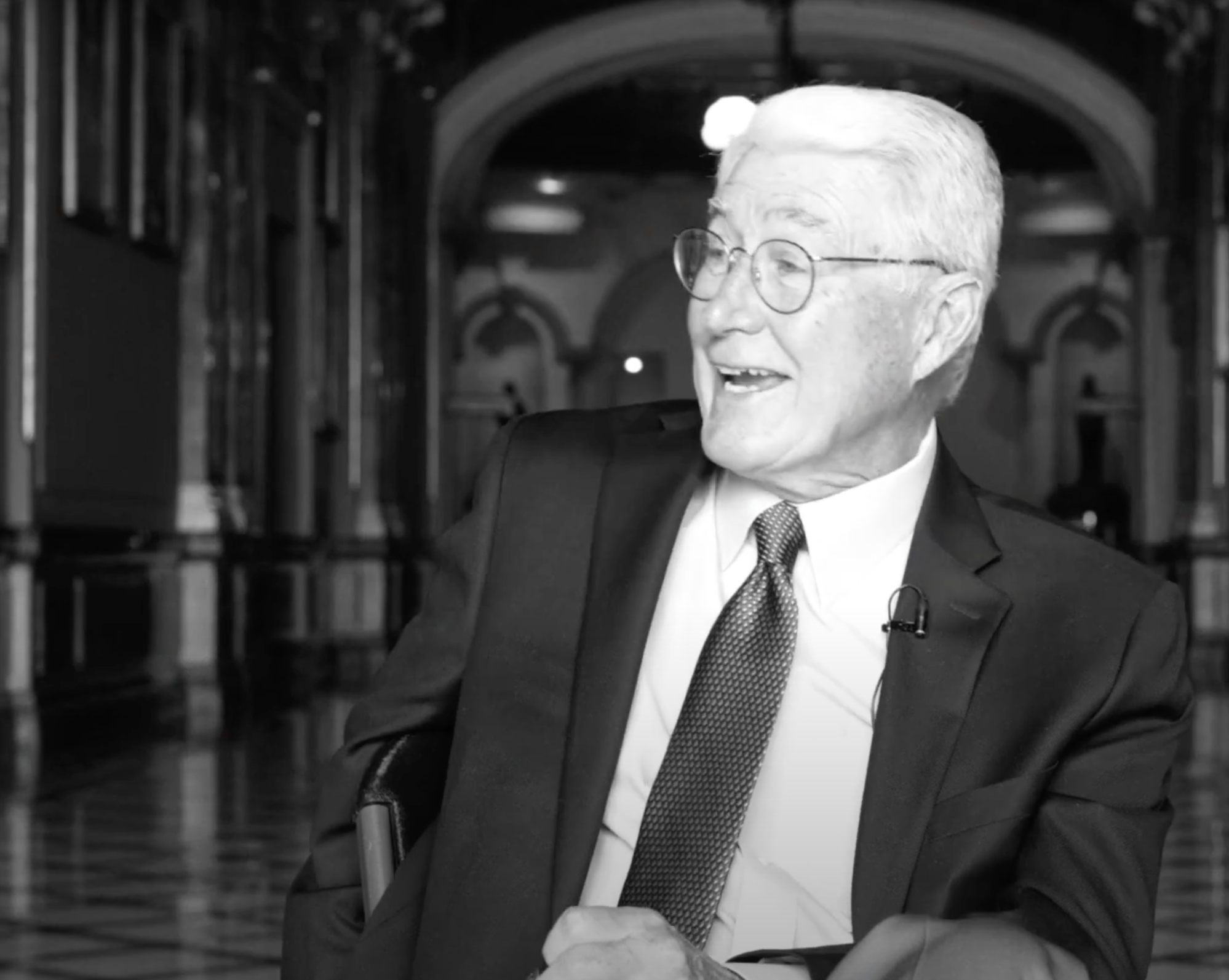
Gov. Jim Edgar, Advance Illinois Founding Co-Chair.
It is with heavy hearts that we write to honor the passing of former Governor Jim Edgar. At a time when political strife is on the rise, Illinois has lost a public servant who believed in public service and in using elective office to bring people together to improve the lives of all families. It is not surprising that Gov. Edgar remains one of the most beloved former governors in the state, or that he leaves a tangible, bipartisan legacy.
While in office, Gov. Edgar tackled thorny issues ranging from ballooning pension debt, and state deficits, to inequitable school funding, and did so while retaining broad-based support. After stepping down as Governor, Jim Edgar resisted calls to run for other offices, choosing instead to speak candidly about political issues and races, and to focus on mentoring the next generation.
In that vein, Gov. Edgar lent his considerable reputation and energy to founding two bipartisan organizations. First, he joined a group of civic leaders who came together to investigate whether and how Illinois could make more significant progress ensuring that every Illinois student had the education they needed to thrive and succeed. The group concluded that Illinois would benefit from an organization that worked on systemic issues and did so across traditional geographic, political, and other divides. Gov. Jim Edgar believed enough in the mission that he agreed to become founding co-chair of Advance Illinois. Partnering with Bill Daley, a well-known Chicago Democrat, Gov. Edgar lent his voice to establishing Advance Illinois as a credible, bipartisan organization committed to using data and research to identify high-impact strategies, and to working across the diversity of Illinois to engage and involve stakeholders.
Several years later, in a similar vein, Gov. Edgar founded the Edgar Fellows Program at the University of Illinois. The program has a simple, but important, goal: to bring the next generation of state leaders together to learn from and with each other about the issues the state faces. Explicitly, the goal was to ensure that every cohort of Edgar Fellows represented the political, geographic, gender, racial, and civic diversity of the state – with a special emphasis on leaders in or likely to pursue elected office. From there, the objective was for Fellows to get to know each other – well enough to work across divides on hard issues. The program boasts over 500 graduates and continues today.

Advance Illinois 15th Anniversary honorees former White House Chief of Staff Bill Daley, former Governor Jim Edgar, and former Illinois State Senator Miguel Del Valle with Advance Illinois President Robin Steans. (November 1, 2023)
As anyone who had the pleasure of working with him will attest, in addition to being a laudable public figure, Jim Edgar was just a wonderful human being. He was unfailingly candid, perceptive, engaging, and warm. At one of his final public appearances, he used his time to lament the importance – and absence – of compassion as a driving force in government. And that basic humanity was just as present up close. It will forever be a personal and professional highlight to have had the opportunity to work closely with Gov. Edgar in launching Advance Illinois. He spent untold hours with me discussing issues of the day, strategizing, or just reflecting on the world – hours filled with real interest in advancing good policy, a keen and self-deprecating sense of humor, and a genuine desire to support others to learn and grow. Jim Edgar cared deeply about Illinois and dedicated himself to finding ways to support its ongoing growth and health – through public service, through education, and through supporting the next generation of leaders.
I know we are not alone in mourning the loss of Governor Edgar. We join an extensive cross-section of the state in sending our condolences to his family and celebrating his legacy. We are grateful for who Gov. Edgar was, and, in turn, what he meant to our organization. Like others, we are committed to carrying on his legacy; to reach across divides to make great things happen for every child and student in our state.
From the Desk—Reflecting on Progress in 2024
What a year this has been! While there have been challenges, including a tight budget, we are grateful that 2024 also brought real progress. As we look ahead to 2025, knowing we face another tough budget year and plenty of changes and challenges, the progress made in 2024 reminds us that positive impact is not only possible, but essential. There is, of course, more work to do, but it is important to pause and appreciate where we have taken important steps, seen meaningful growth, and tackled deep-seated and difficult issues. Then, fortified by the knowledge that we can accomplish hard things when we put our minds to it, we can ready ourselves for the next push.
In Early Childhood, A New Agency and a New Leader!
2024 is the year that Illinois created the Illinois Department of Early Childhood (IDEC), a move that allows the state for the first time to bring together programs that have been managed across three agencies – a move that in turn creates the opportunity to ensure that programs and policies are fairer, more effective, and easier to navigate for both families and providers. Of course, it requires serious focus and visionary leadership to take full advantage of this opportunity. So it is fortunate indeed that the Governor has appointed Dr. Teresa Ramos as the founding Secretary of IDEC. As First Assistant Deputy Governor for Education, Dr. Ramos has been integrally involved in IDEC’s development. A longstanding education advocate (including as Outreach Director for Advance Illinois!), she is committed to working closely with parents, community leaders, providers, and those with technical expertise as the emerging agency shapes key new strategies to strengthen Illinois’ system of early childhood education and care.
We look forward to partnering with Dr. Ramos and IDEC in 2025 and beyond, and will continue to prioritize core recommendations from the Governor’s Early Childhood Funding Commission. These include stable and coordinated funding mechanisms to support high-quality programs, improved system-wide data and analytic capacity to inform programs and policy, and targeted work to retain, recruit and fairly compensate a qualified and diverse ECEC workforce. Importantly, the state has already made meaningful headway on these critical goals. You can read more about the good work already underway in our recent ECEC publication.
K12: Signs of Progress, Areas for Improvement
Along with the rest of the country (and world), Illinois students continue to recover from the impacts of COVID 19 and significant educational and community disruptions. So it was encouraging that the 2024 Illinois School Report Card included news that Illinois students demonstrated academic proficiency that exceeded pre-pandemic levels in English Language Arts, that kindergarten readiness in the state is steadily increasing, that high school graduation rates continue to improve (especially among Black students), and that college-enrollment is ticking back up. That is all worth cheering, and suggests that dedicated, hard work at the local level is making a difference, as is ongoing investment in the state’s equitable school funding formula. At the same time, other data reminds us of the work ahead. The state continues to wrestle with significant equity gaps, math proficiency has not yet rebounded, nor has college readiness, as reflected in SAT scores. As importantly, chronic absenteeism rates – powerful predictors of longer-term persistence and achievement - remain troublingly high, particularly for targeted student groups.
At long last...A Serious Blueprint for Adequate, Equitable, and Sustainable Funding for Illinois’ Public Universities
This year, after more than 2 years of analysis, research and discussion, the Commission on Equitable Public University Funding concluded its work with strong, actionable recommendations for a better way to fund the state’s public universities. As the Senate and House convened hearings on the Commission’s findings, there was a growing and clear consensus that the state’s current funding approach cannot continue; that it is time to move away from a system that does not consider student or institutional need, that is not connected to any state priorities, and is driven largely by politics. Today, SB3965 and HB5907, which operationalize the Commission’s recommendations, have been filed, and higher education leaders and legislators are actively negotiating a final package. We fully expect the General Assembly to take up this critical issue in the coming session, but it is worth pausing to celebrate that for first time, Illinois has a clear roadmap for how to better support students and universities, and to ensure that sufficient funding follows student need. The state now has a ground-breaking model that is (1) anchored in adequacy and equity, (2) with a distribution methodology that acknowledges the diverse needs of students and the specific missions of universities, and (3) prioritizes new dollars for institutions with the least resources while ensuring all institutions benefit.
Also on the higher education front, we can and should celebrate that the state continues to grow the Monetary Award Program (MAP), appropriating at a level that allows all applicants to receive awards, even as it has enabled the state to increase average award amounts. That said, MAP still covers just 55% of average tuition and fees at a four-year public university, compared to 100% coverage in the early 2000s, and Illinois remains one of the least affordable states in the nation to attend college. So the work continues. (And it is worth noting that fixing the state’s public university funding will also help keep tuition rates down.)
Supporting and Strengthening Our Educator Pipeline
Illinois has been building a comprehensive and evidence-based set of strategies to strengthen and grow the state’s educator pipeline. These efforts include a new media campaign to attract the next generation of teachers, investment in new teacher mentoring and coaching, and ongoing work to remove financial barriers for student teachers, bilingual teachers, special education teachers, and aspiring teachers of color. The result? Illinois continues to see increased enrollment in teacher preparation programs and a more diverse set of candidates. Federal stimulus dollars have bolstered these efforts, but in 2024 the state wisely chose to use state dollars to continue key programs, such as the Early Childhood Access Consortium for Equity (ECACE) and teacher affinity groups. We hope the state will continue to invest in these and other critical pipeline programs, particularly as demand for effective and diverse educators increases.
In addition to creating and growing relevant programs, the state took important steps this year to reflect on and revisit key elements of our teacher licensure and evaluation systems. We commend ISBE and the General Assembly for evaluating and seeking to continuously improve these critical systems, which are in place to ensure our educators are effective and well-supported.
Sadly, 2024 also brought some challenges. This year, after several years of historic increases in funding to the Minority Teachers of Illinois (MTI) Scholarship, a 32-year program and one of numerous key investments the state has been making to strengthen and diversify its teaching pool, MTI has come under legal attack.
The lawsuit against MTI alleges discrimination on the basis of race, as the scholarship is limited to teacher candidates of color. The challenge to this longstanding and effective program is misguided, missing the critical point that this scholarship supplements many other programs, and, more importantly, is targeted to address research-based student need. Put simply, Illinois continues to work to undo systemic injustice and to ensure that students of color are given the tools they need to achieve and succeed at the same rate as their peers. Decades of research tells us that students of color do better across a range of outcomes when they have a teacher of color at some point during their schooling. To address this, Illinois launched MTI, making scholarships available to aspiring teachers of color in exchange for those teachers teaching in schools with 30% or more students of color. Discontinuing a strategy grounded in evidence to improve student outcomes is in opposition to our state and our children’s best interests. Accordingly, we expect strong support for HR0942 and SR1303 affirming the state’s compelling interest in maintaining this critical program.
In Conclusion...
Illinois seeks to become the greatest state in the nation to raise a child, and we are working to implement strong, forward-looking, student-centered policies and vision. Consider the transformative change in K-12 education spurred by Evidence-Based Funding (EBF) reform, this year’s massive governance shift in early childhood, and proposals on the table to bring adequacy and equity to the forefront in Higher Education in ways no other state has attempted. We have proven over and over again that when we come together to think boldly, and when we keep students and children at the center, we can and do accomplish important things. On to 2025!