


From the Desk
Our From the Desk publications serve as an avenue for us to discuss in-depth education policy issues that we support.
From the Desk—EBF Has Been Transforming What Our Schools Can Do for Illinois Students. Now What?
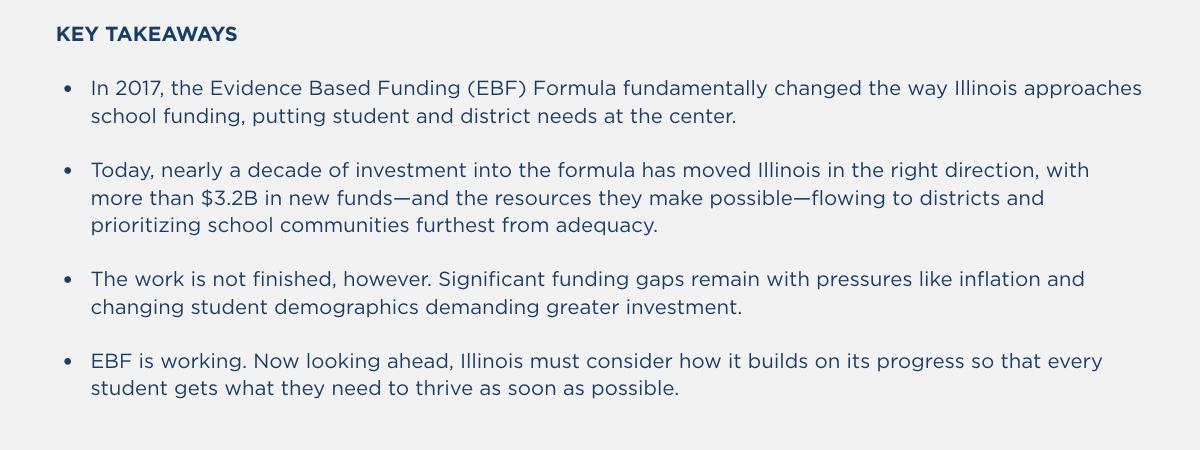
2027 will mark the 10th anniversary of Illinois' bold move to transform the way in which it funds public schools. It is a transformation Advance Illinois helped lead and champion with partners from every corner of the state, and it stands out as one of the most significant policy reforms the state has undertaken in recent memory. Like many of you, heading into this anniversary, I find myself wanting to celebrate, wanting to understand what impact our new formula has had on students and schools, and also wanting to think about the work ahead. I will not cover all of that ground today (watch for in-depth reports on EBF's impact over the course of the coming year), but I'd like to begin what I hope will be a statewide conversation.
Why EBF Was Necessary
Years ago, when conversations around EBF began, the state’s outdated school funding approach placed it 47th in the nation for funding equity – that is, the gap in per pupil spending between low and high poverty districts— and 24th in terms of state share of school funding. Worse still, budget shortfalls meant that even our deeply inadequate state-level foundation funding was being prorated (i.e., districts were only getting a portion of what they’d been promised). Put simply, the system was deeply underfunded and deeply inequitable – both because over-reliance on property taxes meant wildly different resources were available at the local level, and because the majority of state dollars were being spent without regard to local need. The result? Student learning and opportunity depended dishearteningly on zip code.
At the same time, more was being asked of teachers and leaders to help students meet higher standards. This was right and proper, but if we wanted teachers and principals to succeed, they needed the resources required to serve their students well.
For years, the fight was simply to get more money into the system – a system that assumed funding needs were largely the same across districts. But those efforts, while well-intentioned, were inherently inefficient. Why? Because while $10,000 per student might be enough for one district, it might be less than half of what students in another district need to succeed. Without a method for understanding and prioritizing student need across and among districts, Illinois would have to spend dramatically more money than was actually necessary to ensure all students thrived. All this at a time when the state faced serious budget shortfalls, and many schools and districts were cutting every possible corner to make ends meet:
“Prior to the passage of the Evidence-Based Funding model, there was one computer cart that had to be shared between six different grade levels. Since its passage, we are now able to ensure that every student has access to computer technology, including access to a device whenever they need it.
—Dr. Shane Gordon, Bluford USD #318, Celebrating Five Years of Evidence-Based Funding Formula Success, A Superintendent’s Perspective, 8/31/22
“I remember a different time when my district had just 23 days cash on hand, General State Aid had stopped flowing, and districts like ours were faced with the decision to make catastrophic cuts to personnel and programs or close our doors.”
—Dr. Jill Griffin, Bethalto School District #8, ISBE Hearing Testimony, 10/5/2023
How EBF Changed the Game
EBF (SB1) became law in 2017 with bipartisan support, replacing our worst-in-the-nation model with a formula that takes into account student need as well as available local resources. This new approach allowed state and local leaders to, for the first time, understand what each individual district needed to ensure every student thrives – and how far each was from that "adequacy target." That is powerful information, and it allows the state to do something it couldn't do before: target new dollars to support those districts furthest from adequacy, without harming districts with access to more local resources through property taxes. It also shed a light on the very different realities districts were facing across the state. Some were operating well above adequacy (generally due to high property values), while others had dramatically less than they needed. And those high-need districts were rural and urban, large and small, in red counties and blue counties. Moreover, once we all saw and understood the depth and breadth of need, and had a way to understand the deep disparities – not at a conceptual level, but on a district-by-district basis – it was hard to unsee. A powerful coalition came together to push for change (Funding Illinois' Future), and the General Assembly acted.
Importantly, because the formula is dynamic, it ensures that new dollars continue to flow most heavily to students and schools with greatest need. The formula takes into account changing enrollment, changing student demographics, and changing local funding capacity. As importantly, new funds are distributed through a 4-tier system, with 99% of new funds going to schools under 90% of adequacy, and with dollars flowing disproportionately to the students and districts that need them most. That said, EBF also includes a "base funding minimum," so districts never receive less in state funding than they did the year before. Taken together, these features allow high-need districts to "catch up", while ensuring year-to-year funding stability that allows all districts to plan ahead. No wonder it has become a national model!
In addition to adopting EBF, the General Assembly committed to investing $350M new dollars each year to get schools to full funding and to help districts lower local property taxes. Importantly, with the exception of one year (at the start of COVID), they have done just that. The result? Today, more than $3.2 billion in new funds are flowing to districts, thanks to EBF. That's huge! It may be the single most significant and steady funding growth Illinois schools have ever experienced, and it is why Illinois jumped from 47th to 18th in per student funding by 2023.
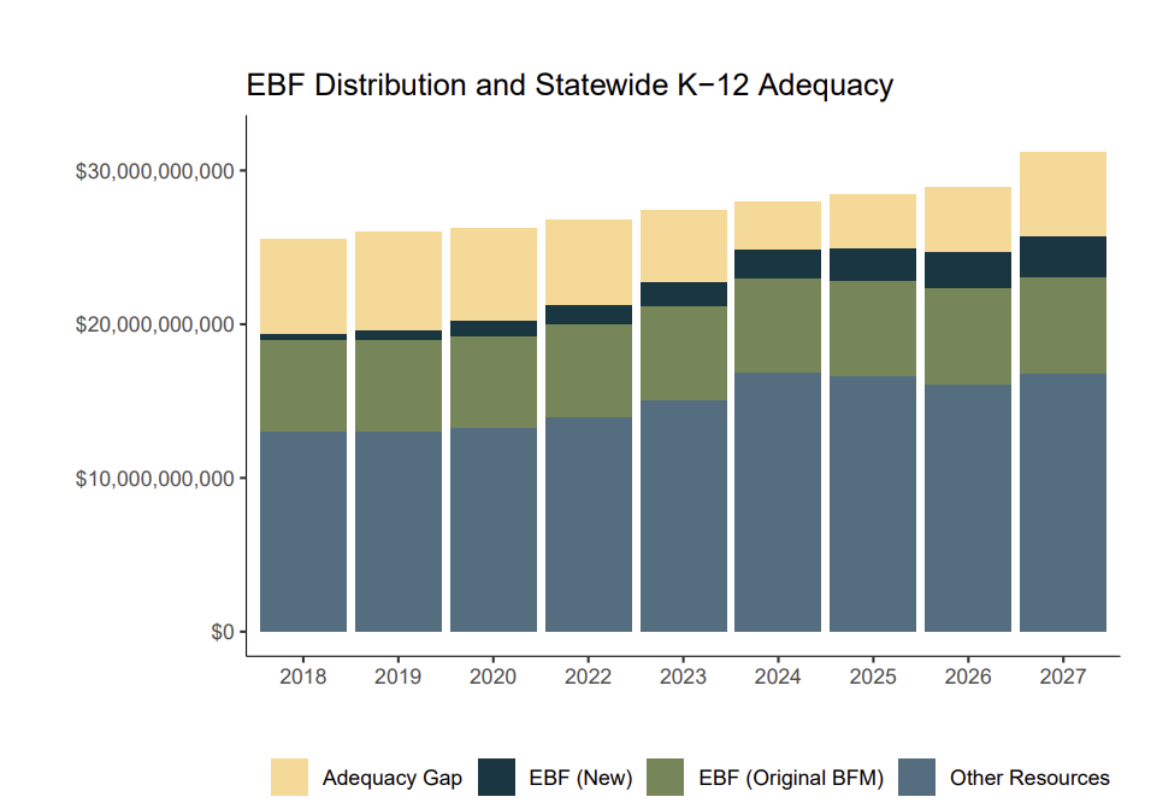
As the formula responds to the changing circumstances of the state—both around cost and changing student needs—our statewide adequacy gap (yellow bar) has changed over time. In FY2024, Illinois saw a significant rise in revenues coming from local sources (largely CPPRT) which meant that many districts were temporarily closer to adequacy. New investments through EBF (navy) have gone into the formula consistently and substantially over this time period.
EBF's Impact Has Been Profound
What has been the impact? The formula has reduced the number of severely underfunded districts (those receiving less than 60 percent of the resources they need) from 168 districts in 2017 to 0 in 2026. It has supported the hiring of more new teachers and counselors, especially for low-income schools and students with special needs. Indeed, EBF has helped lower student teacher ratios: from 15.2:1 in 2009 to 13.2:1 in 2024.
“EBF has directly impacted our ability to invest in curricular resources, provide the staffing we need to meet the diverse needs of our students, and address the much-needed improvements in the learning environments we create for our students. Additionally, because of the investment we have been able to make in our teachers, our retention rate has grown by 5% since 2017 and that makes a significant difference for our students, our families, and the entire community.”
—Dr. Mary Havis, Berwyn South School District 100, Illinois Superintendent Summer Spotlight Series, 2023
“I can say with confidence that without additional dollars invested into Evidence Based Funding my school district will eventually be forced into deficit spending.”
—Ed Fletcher, Monmouth-Roseville School District #238, EBF Advocacy Day Rally 2024
“We have been able to reintroduce elementary physical education, a full-time art teacher, K-12 music classes, and add a social worker. It had been expected of teachers to figure out how to successfully weave these aspects into their lesson planning, but it is no longer necessary.”
—Dr. Shane Gordon, Bluford USD #318, Celebrating Five Years of Evidence-Based Funding Formula Success, A Superintendent’s Perspective, 8/31/22
Put simply, EBF has empowered Illinois school districts to serve their students better.
Thanks to EBF, more resources – like teachers, reading specialists, counselors, afterschool programs, up-to-date curriculum and materials – are available and helping students (and communities) succeed.
Our educational system will sustain our economic growth! These two important items, education, and economic growth, must be on parallel tracks. When and if they don’t match it is hard to run a train successfully down those unmatched tracks
—Dr. Joshua Stafford, Vienna High School District, ISBE Budget Hearing 10/28/2024
But the Work isn’t Finished!
Amid the well-deserved celebration of EBF’s progress, there is urgent work still to do. While the formula has dramatically reduced the number of severely underfunded districts, the statewide adequacy gap remains greater than $3 billion, and three out of four Illinois students still attend school in districts that are not adequately funded.
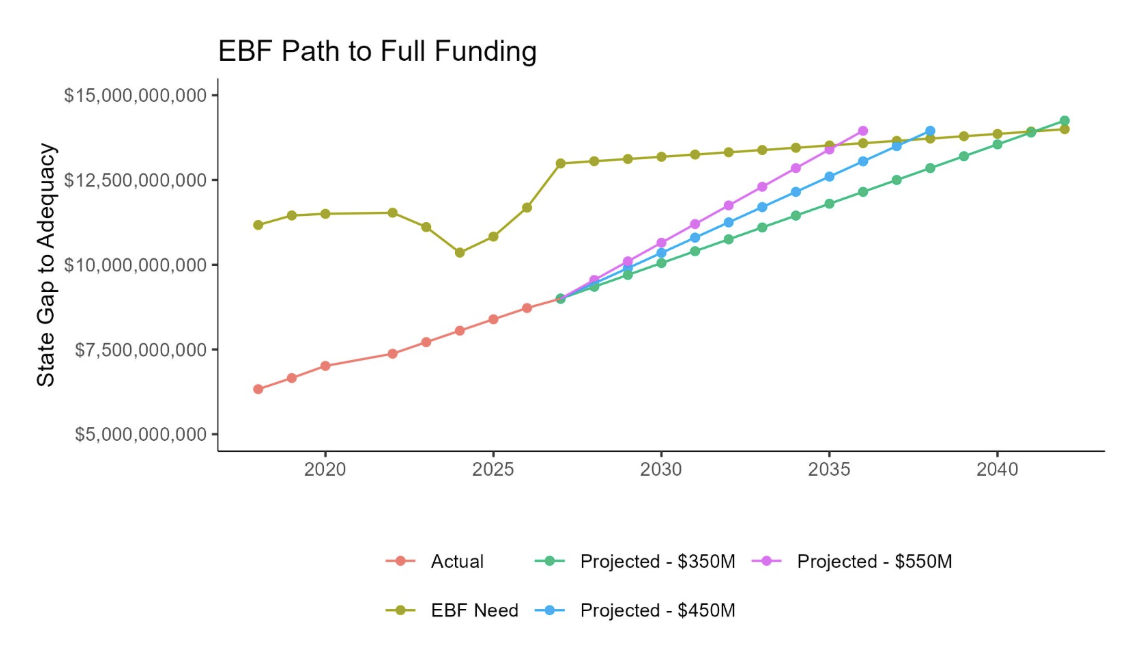
Recent data from ISBE highlight that while the formula continues to successfully increase investments in every district and does so with an equity lens, continued investment at the minimum level of $350M will not keep pace with inflationary pressures and changing student need. On top of that, the (1) drop in CPPRT revenues (corporate and personal property replacement tax) after a 2024 high point and (2) sunset of ESSER dollars left major budgetary gaps in their wake, causing Illinois' overall level of funding adequacy to sag backwards as those revenues declined. As the following chart shows, while progress is being made, increased annual investment is needed to keep districts on track to adequacy and get them there faster.
In Conclusion...
Ten years ago, Illinois lawmakers made a bold decision to create a lifeline for schools and communities across the state. And to their credit, they have remained committed. THANK YOU!
Now, as we approach EBF's 10th anniversary, it is appropriate for state and local leaders to discuss whether there are changes that will help this powerful formula work even more effectively. For our part, we believe thoughtful review is appropriate, and will be sharing ideas over the coming year. In the meantime, let us celebrate the transformative impact EBF has spurred and recommit to a system that identifies local need, efficiently and effectively meets that need, and benefits every Illinois student.
From the Desk—In the Face of Uncertainty, Working Together for Illinois Students and Children
I struggled with how to begin this end-of-year reflection. Like most of you, I am looking forward to taking time with my family as we celebrate the holidays and look ahead to a New Year. But it is hard to know quite what to say about a year that contained such unprecedented change and uncertainty, let alone one that included so much hardship and that is closing with such tragic headlines.
Months of federal actions are changing the landscape of public education. While certainly there was (and remains) room to improve the way in which we operate sprawling and significant federal programs, most changes go far beyond reform. Instead, many undermine decades of hard-won work to safeguard, improve, and expand access to opportunities for millions of children and students in this country who rely on our public schools, as well as programs that ensure families have food and medical care. And while a new administration inevitably brings with it changes in funding priorities, there are forward-looking processes for that change – ones that allow programs and their participants to plan and adjust without causing disruption and harm. In a departure from all norms and legalities, that is not what happened this year.
2025 has brought with it:
Vigorous executive branch efforts to dismantle the Department of Education, notably by dramatic reductions in staff that are causing delays in critical payments and programs, and with an outsized impact on data collection, civil rights enforcement, special education and federal student financial aid programs.
Cancellation or pausing of nearly $900M in research contracts that weaken stakeholder ability to make informed decisions to strengthen practice and policy and, by extension, student achievement.
Punitive demands on institutions of higher education, with critical federal funding threatened or withheld to ensure compliance with demands that exceed (and in some cases pervert) civil rights laws.
Funding that was by turn frozen (then released), rescinded, or delayed – often with little or no notice or process, and outside the normal budgeting process.
Deployment of immigration enforcement officials (and those hastily deputized) to conduct aggressive operations in Illinois and elsewhere that produced little success, by the agency’s own objectives, but sowed fear and loss in communities that spread far beyond the immigrant communities it targeted.
I could go on.
Instead, I will turn to the positive. Despite the issues generated by federal upheaval, Illinois accomplished some important work for children and students:
Protecting Public Spaces of Learning and Care
In the face of aggressive immigration and law enforcement efforts led by the federal administration in states across the country, including our own, the General Assembly passed, and Gov. Pritzker signed, a series of state laws aimed at protecting immigrant and newcomer children, students, and families in public education settings from unlawful immigration enforcement activities. The Safe Schools for All Act (HB3247) codified constitutional law and protects the rights of all students to access public k-12 education regardless of their immigration status. Among other things, the law prohibits schools and districts from disclosing or threatening to disclose the actual or perceived immigration status of students or their caregivers. Further, HB1312, passed in veto session, places similar restrictions on child care staff as well as public colleges and universities, both of which will be prohibited from disclosing citizenship information about students or employees. Children cannot be expected to learn– let alone attend school - if they do not feel safe. Districts including Chicago Public Schools have in fact reported concerning drops in attendance amid ICE raids in the Chicago area, so we applaud lead bill sponsor State Senator Karina Villa and the Latino Policy Forum, Illinois Coalition for Immigrant and Refugee Rights (ICIRR), Mexican American Legal Defense and Educational Fund (MALDEF), The Network: Advocating Against Domestic Violence, Legal Action Chicago, the Law Office of the Cook County Public Defender, Start Early, Illinois Action for Children, and many other advocates for championing this important legislation that enshrines Illinois’ protection for every child and student and their family to learn without fear.
Supporting Student Well-being and Mental Health
As our own State We’re In: 2025 reveals, mental health issues continue to impact student achievement. Chronic absenteeism here and nationally remains at worrisome and high levels, and students continue to report elevated levels of depression and suicidal thoughts. Appropriately, the state advanced efforts to understand and support child well-being and mental health, which are fundamental to learning and growth. Among other things, ISBE released the Children’s Adversity Index in June, which identifies where and to what degree community level trauma is present across the state, putting powerful data into the hands of advocates and lawmakers alike to expand and target resources to foster safer, healthier school communities. In addition, during this past legislative session, state lawmakers passed SB1560 requiring all schools to offer voluntary mental health screenings to students enrolled in grades 3 through 12, at least once a year, beginning with 2027-2028 school year. And to address ongoing attendance issues (which remain one of the most powerful indicators of academic success), the General Assembly created a Chronic Absence Task Force to develop recommendations and report on progress. Finally, at the collegiate level, HB3385 requires all institutions to provide licensed clinical counselors, social workers, or other mental health professionals on campus. With more tools capturing greater insight into student mental health and community conditions, and more mental health personnel being deployed on college campuses, Illinois is setting the stage for healthier schools and more data-driven decision making to sustain them.
Establishing Key Systems for Transparency and Accountability
This year, the state was successful in paving a path for more data-driven decision- making, and greater equity and access at both the early childhood and postsecondary levels. SB0406 creates a new Early Childhood Integrated Data System (ECIDS) to collect, integrate, store and report on early childhood data across programs and agencies. While it will take time for ECIDS to be up and running, it is badly overdue and will help anchor critical work going forward allowing the agency to develop tools for parents and communities to access aggregated data On the other end of the education spectrum, SB2039 calls for a new public-facing and centralized higher education dashboard to report on everything from institutional affordability to student enrollment, persistence, and completion, starting in 2027. These developments strengthen the state’s education data infrastructure and transparency, and they could not come at a more urgent time, as federal actions have slashed data and research support and infrastructure.
Making sure that all children have what they need to live up to their full potential remains one of the most important responsibilities we all have. It is both the right thing to do, and it is the surest way to strengthen the future for all of us. The United States was among the first in the world to recognize the importance of educating every young person and to invest (however imperfectly) in public education for all. Leaders of every political stripe have understood and championed the value of strong public schools, not just to ensure economic and political vitality, but to forge civic and community relationships. And Americans from every corner of the country have consistently reaffirmed the value of meeting children where they are.
As we head into 2026, I hope that these strong and common values will ensure that we continue to not only invest in the next generation, but that we do so with the understanding that we all benefit when everyone has the chance to learn and grow.
So let us recommit ourselves to focusing on the next generation; on what they need to succeed. And let us take time this holiday season to appreciate those who support our young people in classrooms and childcare centers and college campuses. Let us rest and rejuvenate with family and friends…then come back together to make a positive difference in the New Year.
Warmly,
Robin