Advance Illinois Statement Regarding the FY27 State Budget
In the midst of ongoing fiscal pressures at the state level and uncertainty on the federal front, the Illinois General Assembly passed a “steady-on” budget that, while short on bold moves for our education system, reflects a continued prioritization of Illinois children, students and families.
“We recognize and appreciate the efforts of the General Assembly across early childhood, K-12, and higher education,” said Robin Steans, president of Advance Illinois. “While there is more to do, particularly in higher education, it is clear the state remains committed to strengthening opportunities for students.”
Key Takeaways
EARLY CHILDHOOD EDUCATION AND CARE
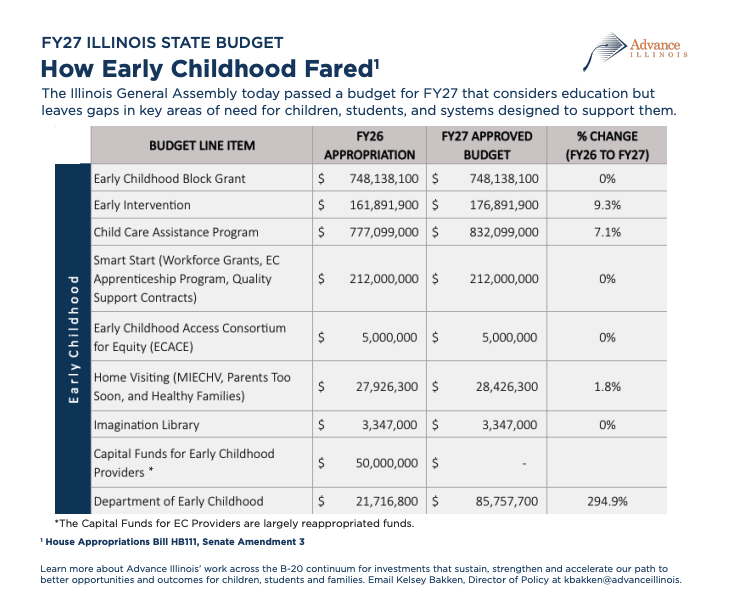
In the FY27 approved budget, we see the state working to maintain progress for children and families amid ongoing fiscal constraints and significant federal changes. That said, this maintenance approach to spending in key areas falls short of meeting the needs of the early childhood workforce, providers, and the young children they serve. We are therefore pleased that the General Assembly increased funding ($15M) for Early Intervention (EI). This is a step in the right direction, but more needs to be done to reduce wait times for young children with developmental delays and disabilities, and to better compensate the EI workforce. We also applaud the $55M increase for the Child Care Assistance Program (CCAP) for FY27. The increase helps address the growing need for home childcare providers, though it fails to increase reimbursement rates for childcare centers. Flat funding for the Early Childhood Block Grant, Smart Start Workforce Grants, Early Childhood Access Consortium for Equity (ECACE), and Home Visiting were undoubtedly hard choices, and the work ahead on these critical programs is clear. In particular, it is critically important that Illinois find a way to increase investment in ECBG to expand access to high-quality pre-K.
K-12 FUNDING
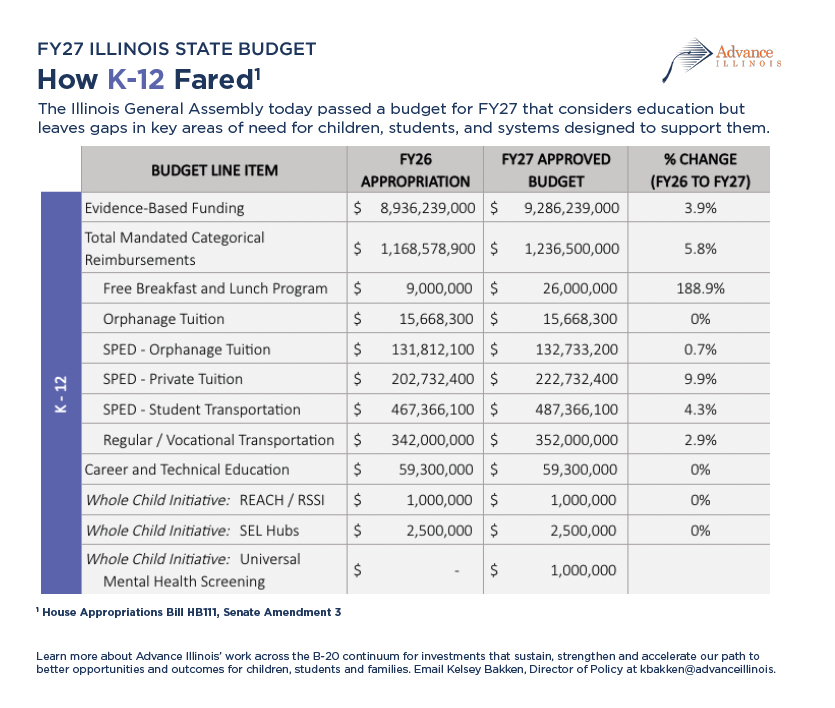
As the 10-year anniversary of Evidence-Based Funding approaches, we applaud the General Assembly’s steadfast commitment to funding the formula to ensure every school district remains on a path to full funding – even in a strained budget year. Continued investment through the formula is delivering meaningful progress across the state. Since 2017, the formula has reduced the number of severely underfunded districts—those receiving less than 70 percent of the resources they need – from 459 districts to just 56 districts in FY26. All the same, should Illinois continue to invest at the rate of $350M (with about $50M of that for Property Tax Relief Grants), our system will not reach full funding before 2040— when today’s kindergarteners will have graduated high school. Currently, three out of four Illinois students still attend school in districts that are not fully funded, with a statewide gap of more than $3B remaining to reach adequacy. Parents, students, and educators experience the consequences of these funding gaps, especially those in under-resourced communities with the greatest need.
We also appreciate other efforts to support our K-12 system. The FY27 appropriation for Mandated Categoricals (MCATs), an increase of $67.9M, reflects a greater increase than we have seen, and it will help address inflationary pressures. That said, without more significant growth to these operational necessities, proration rates will likely worsen with rising claims. While we appreciate the increased allocation for the Free Breakfast and Lunch Program to buttress against the loss of the federal funds, stable and adequate funds remain as important as ever, particularly amid unacceptable proration rates for other key services like transportation and special education tuition. Looking ahead, lawmakers must find a way to increase the state’s rate of investment for both EBF and MCATs to make sure every school district is sufficiently funded to effectively serve their students.
EDUCATOR PIPELINE
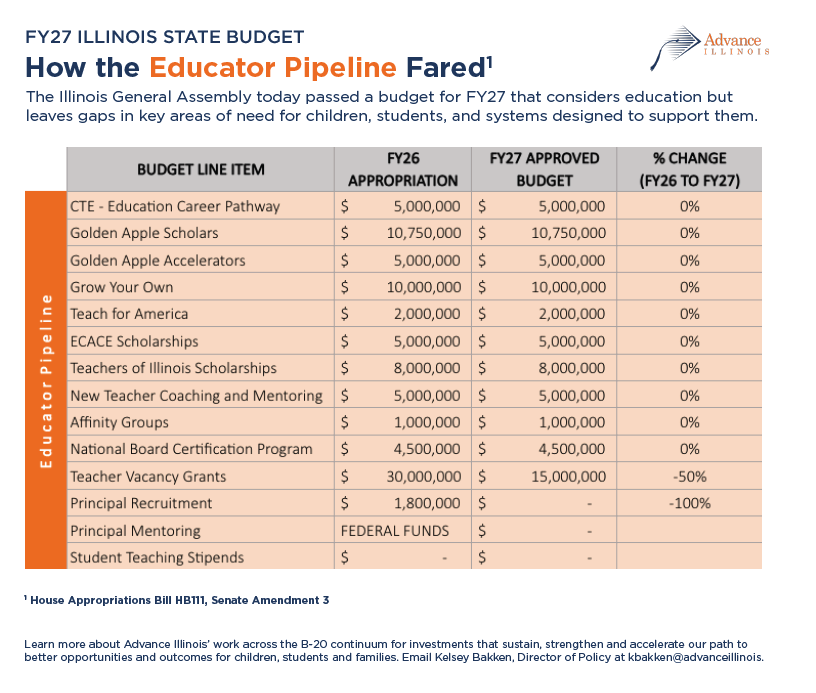
Like many other states, Illinois needs to strengthen and diversify its educator workforce. The approved FY27 state budget presents concerns, but manages to maintain some key programs.
And while we would like to grow proven pipeline programs such as Golden Apple Accelerators, Grow Your Own (including the Diverse Male Teacher Initiative), Teach for America, Teacher Vacancy Grants, and new teacher mentoring and induction, we appreciate that these programs were maintained. At the same time, we are disappointed to see that critical Principal Recruitment and Mentoring programs were not funded in the new budget. Further, paid student teaching was not funded in the new budget. This is a critical program that would help recruit and train qualified teachers, while reducing financial barriers for candidates interested in the profession.
CARING FOR THE WHOLE CHILD
We are pleased to see that Illinois continues to prioritize investment in programs that help schools address growing student mental health needs. In a tough fiscal environment, we appreciate the legislature’s approval to maintain level funding for Resilience-Supportive Schools Illinois (RSSI) and Social-Emotional (SEL) Hubs, and are pleased to see funds allocated ($1M) to support the roll out of Universal Mental Health Screenings.
HIGHER EDUCATION
MAP
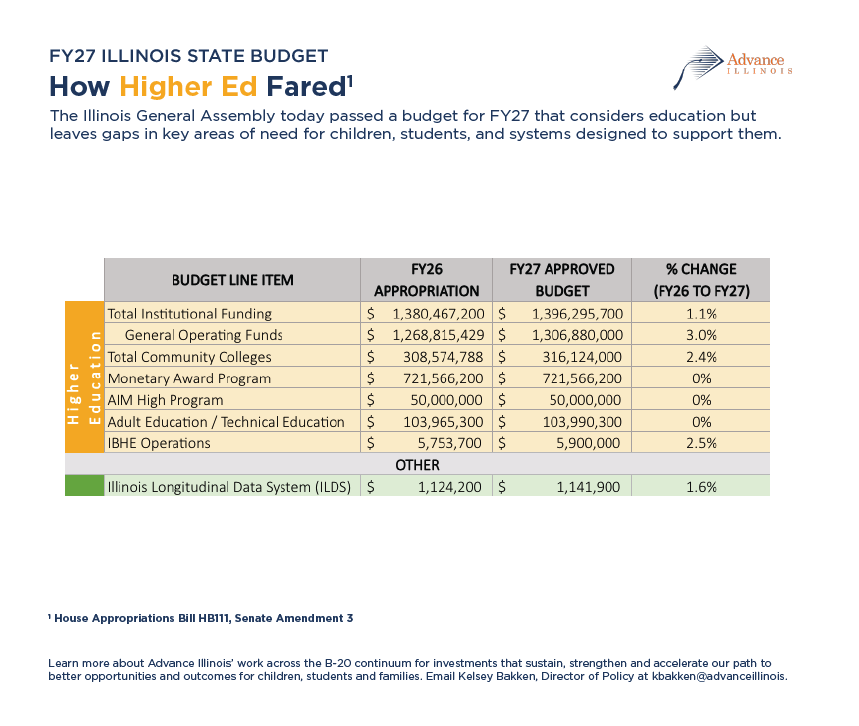
The Monetary Award Program (MAP) is a lifeline for college access, so it is disheartening that the General Assembly approved flat funding for FY27. Without additional funds, we are likely to see the continued suspension of MAP grants next year, leaving otherwise-eligible applicants without support because funding has run out. This means more students will have to take out loans, work long hours, and/or only attend school part-time to make up the difference—if they decide to attend college at all. Importantly, MAP now covers only 47% of what it costs to attend a public university in the state, so those students who receive a grant still have a significant way to go in covering the true cost of attendance. Given its purpose of supporting students with financial needs, underfunding MAP harms Illinois’ students from low-income households, and treats higher education as a privilege for some, rather than a resource for all. We recognize the financial pressures on the state, but the lack of a MAP increase runs counter to the goal of expanding access, affordability, and equity in higher education.
INSTITUTIONAL FUNDING
As we continue to work with lawmakers and collaborate with advocacy partners in calling for the passage of the Adequate and Equitable Public University Funding Act (SB13/HB1581), our state must prioritize distributing new funds in ways that respond to the different needs facing Illinois’ 12 public universities.
We appreciate the General Assembly approving a 1% increase from FY26 for public universities in a tight budget year. That said, the increase does not begin to match inflation for a system that is already deeply underfunded. As importantly, the across-the-board increase approved for FY27 maintains the (inadequate) status quo for our public universities overall and represents a missed opportunity to allocate new funds based on mission and need. Illinois’ students deserve affordable access to quality, well-resourced institutions that have the wherewithal and programs they need to thrive and graduate. In short, Illinois’s students deserve better.
This cannot happen without the state stepping up and revamping its approach to funding our public universities. If the state does not identify a sustainable revenue source to fund the Adequate and Equitable Public University Funding Act, then we urge the legislature to make it a priority going forward to distribute any new dollars equitably and in a manner aligned with the goals of the bill’s formula.
PROTECTING PROGRESS FOR STUDENTS IN FACE OF FEDERAL CHANGES
We applaud the state’s ongoing work to respond to federal changes in funding, data collection, eligibility for safety net programs, and civil rights enforcement. The impacts of federal decisions and cuts are being felt already and will have implications over time that affect educational quality and access and family stability. We are therefore pleased to see funding ($200,000) to support ISBE in developing a new way of counting students from low-income households, as it is certain that student eligibility will drop due to SNAP changes approved in H.R.1.
In Conclusion
We appreciate the General Assembly for sustaining critical areas of work and progress while tackling fiscal pressures at the state level. These pressures - exacerbated by federal changes - intensify the urgency for state action and investment to protect and improve outcomes across the B-20 system. As we look ahead, we will continue to collaborate with advocates and state leaders to ensure our education system can provide what Illinois children, students, and families need to flourish. The future of our state depends on it.