

It is encouraging to see that Illinois is making progress in kindergarten readiness in comparison to last year, but the latest Kindergarten Individual Development Survey (KIDS) data show the persistent problem that too many children are still beginning their school journey without the developmental skills they need to thrive.
Illinois measures kindergarten readiness through the KIDS, an observational assessment that kindergarten teachers use to understand children's development as they enter school. KIDS looks at children's skills across three important developmental domains that are essential building blocks for learning:
Social-emotional development: Skills such as self-regulation, interacting with others, building relationships, and managing emotions.
Language and literacy: Skills that support communication, understanding language, early literacy, and the foundations for reading.
Math: Early mathematical thinking, including concepts and skills that prepare children for learning mathematics.
Designed to provide a picture of children's development and help educators understand where children are thriving and where they may need additional support, KIDS is not a traditional standardized test. Instead, teachers use observations of children's everyday activities and interactions to assess 14 required measures across these domains.
Pieces of encouragement and areas of concern
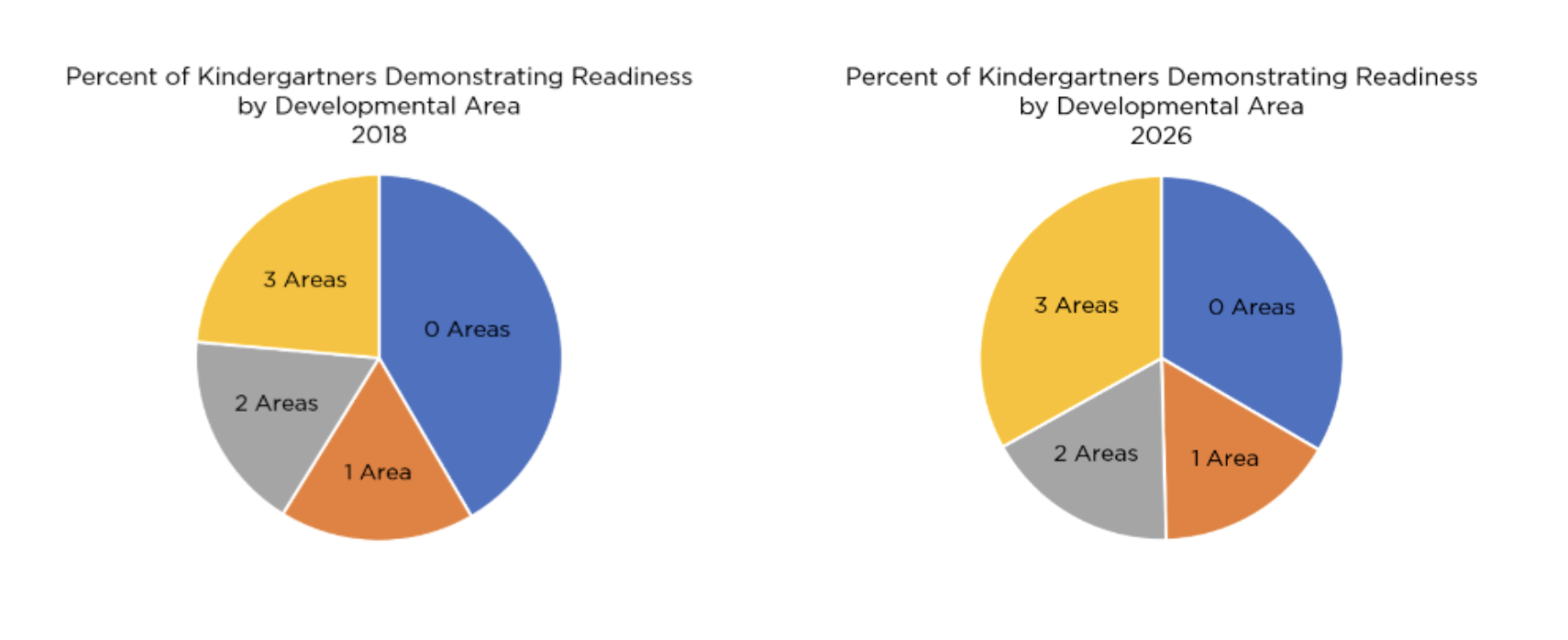
The good news from the most recent data shows that slightly more children are entering kindergarten ready across the developmental domains, reaching a record high of 33.1%, up from 31.5% in 2025 and up nearly 10 percentage points since the inception of KIDS in 2018. This progress suggests that more young children in Illinois are benefiting from the early learning experiences, services, and supports that help build a strong foundation as they begin school.
But the data also underscores how much work remains. Nearly two-thirds of incoming kindergartners do not demonstrate readiness across all three of the developmental areas. And while fewer children are entering kindergarten without demonstrating readiness in any of the three areas, that number remains a point of concern.
Progress is happening, but disparities remain
There is reason to feel encouraged that kindergarten readiness is improving across the state, including among several groups of children who have historically faced greater barriers to accessing early learning opportunities. However, statewide averages do not tell the whole story, with significant differences in readiness existing across demographic groups with fewer Black and Latinx students entering kindergarten found ready across all three developmental domains, Children living in poverty, experiencing homelessness, and English learners and children with IEPs are also less likely to be prepared for kindergarten.
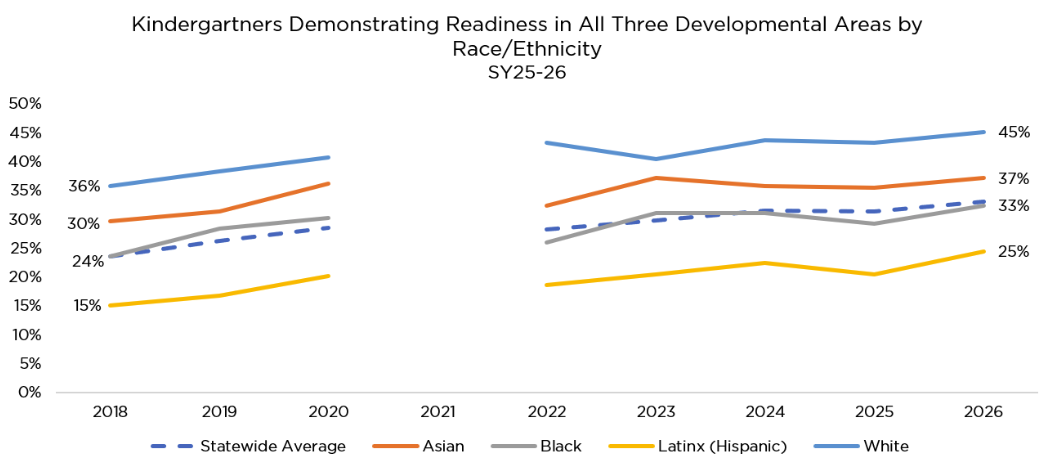
While Black and Latinx students saw slight increases in kindergarten readiness rates from SY24-25, growth for Black and Latinx students continues to fall behind White students. White and Asian students are 13 to 21 percentage points more likely to enter kindergarten ready than Black and Latinx students.
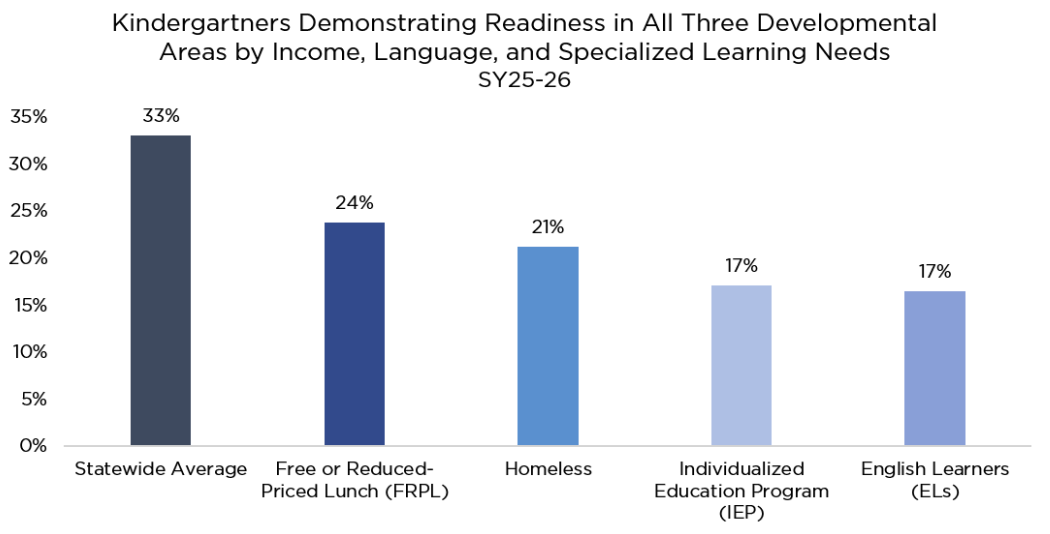
English Learners (ELs), students eligible for Free and Reduced-Priced Lunch (FRPL), students with IEPs, and students from families experiencing homelessness were 9 to 17 percentage points less likely to demonstrate kindergarten readiness in all three developmental areas.
These differences reflect significant disparities in access to early childhood education and care across Illinois. According to the Civic Federation's 2026 Illinois Early Childhood Landscape, licensed childcare providers have the capacity to serve only 31.7% of children ages birth to five statewide—and just 21% of infants and toddlers. Nearly three-quarters of Illinois counties are considered childcare deserts. Illinois Facilities Fund's statewide needs assessment similarly found that fewer than half of Illinois children age five and under had access to an early childhood education provider close to home, with particularly limited access in rural communities and many high-poverty neighborhoods in Metro Chicago. These gaps mean that children in communities with the greatest needs often face the greatest barriers to accessing early learning experiences and developmental supports that help prepare them for kindergarten.
Importance of statewide data
As KIDS is the only statewide measure of young children's developmental readiness for school, the quality and usefulness of data depends on consistent implementation and strong participation. So, it is heartening to see increased school district participation in KIDS – up four percentage points from last year, from 87% to 91%. Higher participation rates are critical for producing meaningful and useful statewide data that provides a complete picture and can help inform decisions that help children and families across the state.
Turning progress into a stronger start for every child
While the latest KIDS results indicate signs of progress, they also reinforce the need for continued investment and ongoing action.
Illinois must continue to support strong implementation of KIDS. Educators need ongoing training, coaching, and resources to use the assessment effectively and consistently. When educators have the support to implement KIDS consistently, state leaders and educators can take greater confidence in the results to provide a reliable picture of children's development.
Supporting proven strategies that increase readiness is essential as well. At this year’s KIDS Summit, hundreds of educators, coaches, and administrators convened to learn about the critical role of play-based learning in supporting children’s development and offers a setting in which teachers can observe holistically. School districts that had recently begun to implement play-based learning in their kindergarten classrooms, provided educators with a roadmap to embed play-based learning into their daily instruction, and shared strategies for administrators to integrate play-based learning environments across their district. Expanding the use of play-based learning across the state will not only strengthen the KIDS data, but also provide families, educators, and administrators with the tools to support children’s development and ongoing learning.
Finally, the insights revealed through KIDS data itself present a powerful tool for the state to advance adequacy and equity in its early childhood system. The persistent differences in kindergarten readiness across student groups and communities make clear that Illinois must continue to identify where gaps are greatest and in turn, direct resources, services, and supports accordingly. This includes communities with limited access to early learning opportunities and children who may benefit from additional developmental supports.
In a previous era, the decentralization of early childhood services and data across three agencies complicated the work of advancing quality and equity for the thousands of children and families served by the system. However, through the creation of a single department of early childhood (IDEC), the resulting ability to have unified data through ECIDs, and the ongoing development of improved statewide data more broadly through ILDS, a more efficient path to sustaining and accelerating progress for Illinois children is within reach. As more integrated data becomes available, KIDS insights will play a pivotal role in connecting the dots between high-quality early learning experiences and kindergarten readiness. When we put that knowledge to work, and collaborate in partnership, we, as a state, can ensure our youngest learners have a strong and equitable start towards success.