


Blog
Our blog provides readers an opportunity to hear from the Advance Illinois staff and partners on education policy issues affecting Illinois students and beyond.
Early Childhood Education and Care Is an Investment in Our Future
Our Early Childhood Education and Care is Essential campaign reviewed the impact of high-quality programs for children, families, communities and state, highlighting challenges for providers and the workforce. While there is more work to be done, Illinois is making progress in strengthening its early childhood education and care ecosystem, including with the recent launch of the Department of Early Childhood, a unified agency to better support families and providers. And continued investments in programs that help young children thrive and prepare for kindergarten show a commitment to our youngest learners, their families, providers, and the future of our state.
The research is clear, high-quality early learning programs improve educational, social, and health-related outcomes in children, setting the foundation for long-term well-being and academic success. School readiness is improved by building cognitive and social-emotional skills that children need to thrive in school. Research also shows that early experiences in the home, in other care settings, and in communities shape the development of a child's brain, particularly in the first five years. High-quality early learning opportunities are essential in giving Illinois’ youngest learners a strong start.
When childcare is unaffordable or inaccessible, it creates barriers, forcing many families to make difficult decisions, impacting their financial security, and young children’s stability. In 2026, 69% of children in Illinois have all available parents participating in the workforce, while the average cost of care is $19,807 a year (or $1,651 per month). Studies show that parents of children under age six needing to make job changes due to challenges with childcare, such as leaving or not taking employment. This has led to $172 billion in lost earnings and productivity each year involving families with children under age five, further impacting the economy. In Illinois alone, $6.2 billion was lost due to childcare challenges involving families with infants and toddlers. Fortunately, programs like the Child Care Assistance Program (CCAP) help families pay for childcare while parents work or attend school.
Where families reside plays a role in childcare access. An estimated 49% of Illinois children live in a childcare desert, with disproportionate impacts felt by low-income, rural, Latinx, and communities of color. In Illinois, CCAP participation rates varied widely by region. In some areas of the state, fewer than 20% of eligible children were enrolled, while in others, over 50% participated. These differences reflect local and regional accessibility, provider availability, and awareness of the program. To support working families and those eligible for childcare cost assistance, reducing childcare deserts and raising program awareness is a necessity.
The early childcare workforce also plays a pivotal role in the early years of our youngest learners, yet they are chronically undercompensated. Without educators, providers often have to reduce enrollment or close classrooms, creating greater access barriers for families. Investments in early educator pay and benefits are associated with improved retention in the early childhood workforce, stronger program stability, and better educator well-being. The Smart Start Workforce Grant (SSWG) program has allowed providers to improve staff wages while continuing to deliver high-quality education and care. In addition, providers receiving SSWG have a higher average enrollment of children receiving support through CCAP - increasing equity and enhancing access to families who need it most.
In recent years, Illinois has laid critical groundwork in early childhood care. With the Department of Early Childhood now a reality, the agency will support the state’s ability to identify gaps, and address challenges within the ecosystem. In addition, the forthcoming Early Childhood Integrated Data System (ECIDS) will bring early childhood data from across programs and agencies together to help Illinois better understand the needs of children and families, improve service, and make more informed decisions. There is also ongoing work to align funding and programming, ensure equity-based funding adequacy targets are set across service areas, and establish a strong regional infrastructure. As Illinois continues to strengthen the future of our state, sustained investments in these programs are critical to ensure every child and family can access high-quality early learning and care so they can thrive and succeed.
Eucarol Juarez is the Senior Communications Associate at Advance Illinois
Childcare Remains Unaffordable for Families and Unsustainable for Providers
While Illinois has continued progress in expanding access to early childhood education and care, rising costs and workforce challenges continue to impact families and providers.
This summer, our Childhood Education and Care is Essential campaign will review why high-quality early childhood education and care is essential for a stronger and equitable system. The campaign will discuss workforce compensation, cost of care, equity and access, and the impact on children, families, and communities.
Childcare Remains Unaffordable for Families and Unsustainable for Providers
For Illinois families with young children, childcare has become one of the largest household expenses, competing with housing, food, transportation, and healthcare. According to Child Care Aware of America, the average annual cost of licensed center-based childcare in Illinois can exceed $19,000 for an infant and $14,000 for a preschool-age child. In many communities, the cost of childcare rivals—or exceeds—the cost of housing or public college tuition, placing an enormous strain on family budgets.ⅰ As these costs continue to rise, many families are forced to make difficult decisions about employment, education, and financial stability simply because they cannot afford the childcare they need.
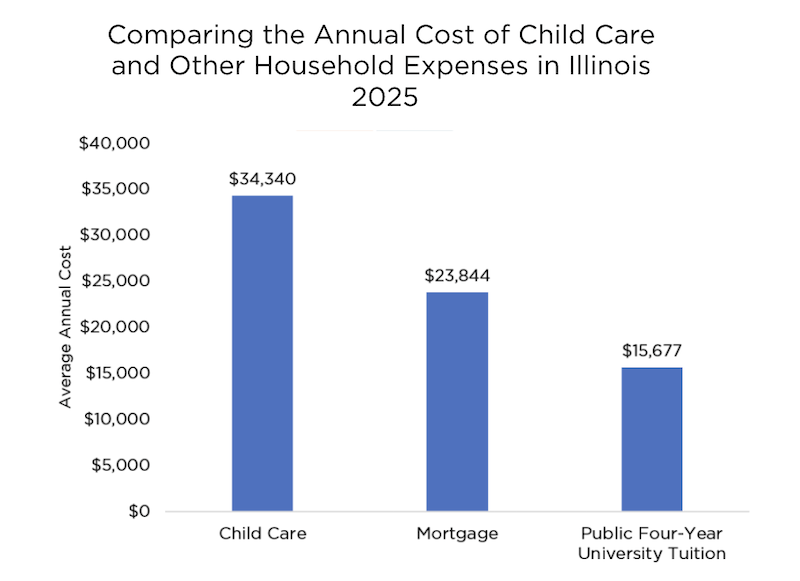
Source: Child Care Aware’s Child Care in America: 2025 Price & Supply Report
Childcare costs in Illinois far exceed the federal standard for affordability – defined as costing no more than 7% of a family's household income. In Illinois, however, the average annual price of center-based infant care consumes 2-7 times that threshold with approximately 14% of the median income for a married-couple family and 48% of the median income for a single-parent family.ⅱ These figures illustrate that, for many Illinois families, the cost of childcare is not simply a budgeting challenge—it is a significant barrier to economic security and workforce participation, even before accounting for the cost of caring for additional children.
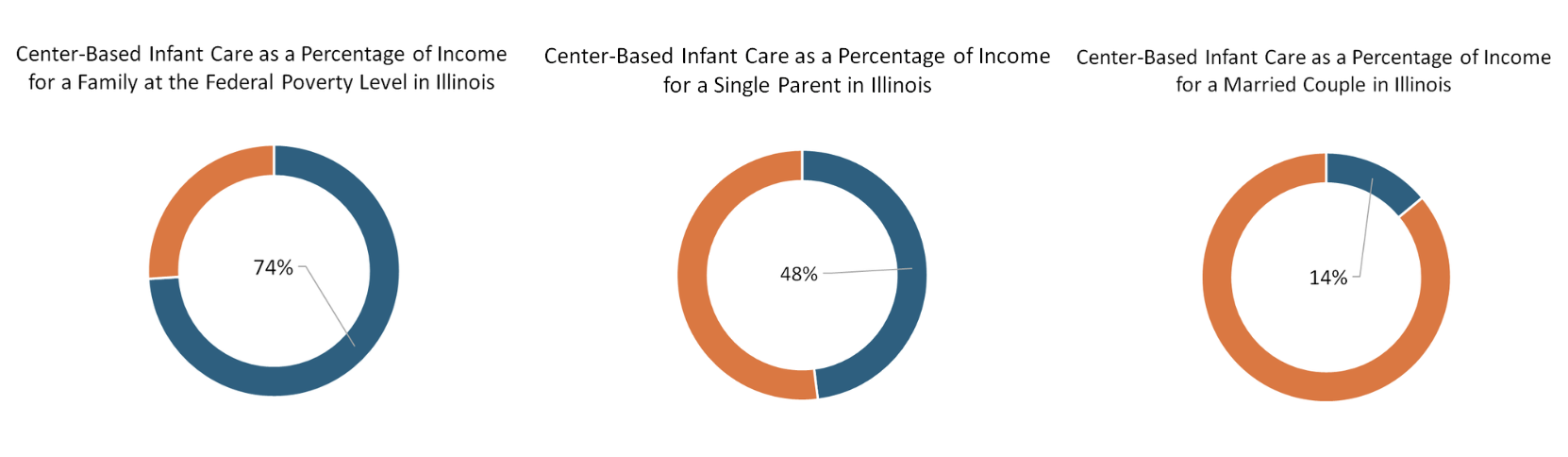
Source: Child Care Aware of America survey (child care prices), U.S. Census Bureau, American Community Survey, Table B19126 (median income)
Meanwhile, providers face rising expenses for educator wages and benefits, facilities, insurance, food, classroom materials, and regulatory compliance. Yet there is little room to increase tuition because many families are already at or beyond what they can reasonably afford. The result is a market-based financing structure that asks families to shoulder costs they cannot sustain while expecting providers to deliver high-quality care with inadequate resources.
While the Illinois' Child Care Assistance Program (CCAP) helps 86,000ⅲ with lower incomes each month afford childcare while they work, attend school, or participate in approved training activities, the subsidy does not always eliminate affordability challenges. Illinois establishes CCAP reimbursement rates using a market rate methodology, which sets maximum payment rates based on prices charged in the childcare market. When a provider's tuition exceeds the state's reimbursement limit, families may be responsible for paying that.ⅳ
This disconnect exists because market prices reflect what families are able to pay—not what it actually costs to provide quality childcare. Childcare is one of the few essential services where the price families can afford to pay is fundamentally disconnected from what it costs to provide quality care. The estimated gap between CCAP reimbursement rates and the true cost of care to provide high-quality ranges from $6,000 for preschoolers to nearly $17,000 for infants.ⅴ The result is a financing system that leaves both families and providers under financial strain.
Illinois cannot solve its childcare affordability challenge by focusing only on families or only on providers. Reducing costs for families without strengthening provider financing risks shrinking the supply of care. Increasing provider resources without improving affordability leaves many families unable to access available programs. Family affordability and provider financial sustainability are two sides of the same equation. Until Illinois closes the gap between what families can afford to pay and what quality childcare actually costs, families will continue to struggle to access childcare, limiting their children's access to high-quality care and early learning opportunities while providers will continue to struggle to provide it.
Kate Buchanan is the Senior Policy Advisor, Early Childhood for Advance Illinois.
Sources
ⅰ. Child Care Aware of America. (2025). Child Care and Early Education Profile: Illinois.
ⅱ. Child Care Aware of America. (2025). Illinois Child Care Affordability Fact Sheet; Child Care Aware of America.
ⅲ. Illinois Department of Human Services Division of Early Childhood, FY25 Illinois Child Care Program Report,https://www.dhs.state.il.us/OneNetLibrary/27897/documents/EC/ADA%20FY25%20Illinois%20Child%20Care%20Program%20Report.pdf?utm_source
ⅳ. Illinois Department of Human Services. 2023 Illinois Child Care Market Rate Survey; Illinois Child Care Assistance Program Policies; 45 C.F.R. § 98.45, Equal Access for Child Care Services. https://www.dhs.state.il.us/OneNetLibrary/27897/documents/MarketRateSurvey/MarketRateSurvey2023_A11Y.pdf
ⅴ. Ritter, K., & Hawley, T. (2021). Cost Model for Early Childhood Education and Care Services. Illinois Governor’s Early Childhood Funding Commission.