

Childcare Remains Unaffordable for Families and Unsustainable for Providers
While Illinois has continued progress in expanding access to early childhood education and care, rising costs and workforce challenges continue to impact families and providers.
This summer, our Childhood Education and Care is Essential campaign will review why high-quality early childhood education and care is essential for a stronger and equitable system. The campaign will discuss workforce compensation, cost of care, equity and access, and the impact on children, families, and communities.
Childcare Remains Unaffordable for Families and Unsustainable for Providers
For Illinois families with young children, childcare has become one of the largest household expenses, competing with housing, food, transportation, and healthcare. According to Child Care Aware of America, the average annual cost of licensed center-based childcare in Illinois can exceed $19,000 for an infant and $14,000 for a preschool-age child. In many communities, the cost of childcare rivals—or exceeds—the cost of housing or public college tuition, placing an enormous strain on family budgets.ⅰ As these costs continue to rise, many families are forced to make difficult decisions about employment, education, and financial stability simply because they cannot afford the childcare they need.
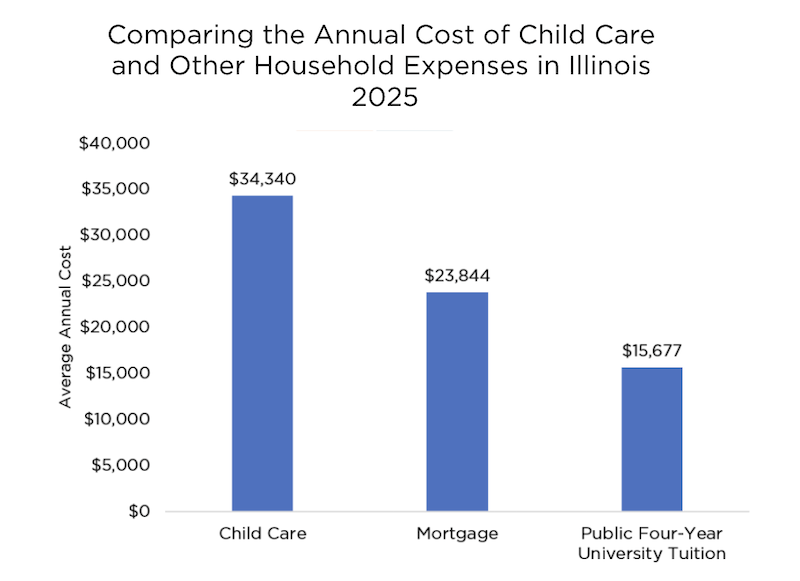
Source: Child Care Aware’s Child Care in America: 2025 Price & Supply Report
Childcare costs in Illinois far exceed the federal standard for affordability – defined as costing no more than 7% of a family's household income. In Illinois, however, the average annual price of center-based infant care consumes 2-7 times that threshold with approximately 14% of the median income for a married-couple family and 48% of the median income for a single-parent family.ⅱ These figures illustrate that, for many Illinois families, the cost of childcare is not simply a budgeting challenge—it is a significant barrier to economic security and workforce participation, even before accounting for the cost of caring for additional children.
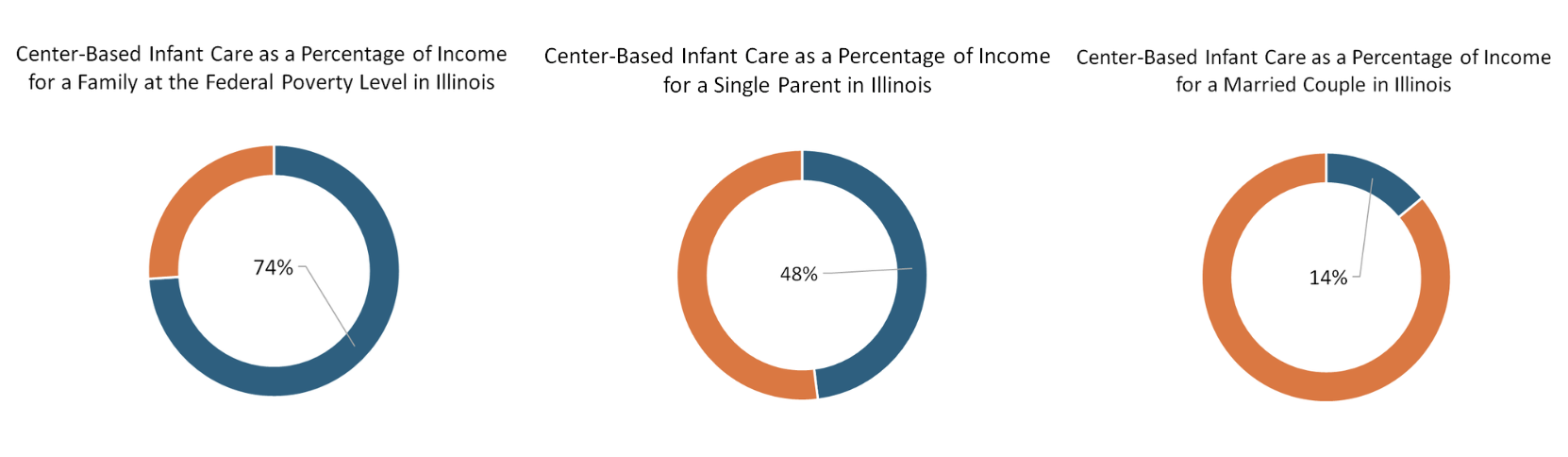
Source: Child Care Aware of America survey (child care prices), U.S. Census Bureau, American Community Survey, Table B19126 (median income)
Meanwhile, providers face rising expenses for educator wages and benefits, facilities, insurance, food, classroom materials, and regulatory compliance. Yet there is little room to increase tuition because many families are already at or beyond what they can reasonably afford. The result is a market-based financing structure that asks families to shoulder costs they cannot sustain while expecting providers to deliver high-quality care with inadequate resources.
While the Illinois' Child Care Assistance Program (CCAP) helps 86,000ⅲ with lower incomes each month afford childcare while they work, attend school, or participate in approved training activities, the subsidy does not always eliminate affordability challenges. Illinois establishes CCAP reimbursement rates using a market rate methodology, which sets maximum payment rates based on prices charged in the childcare market. When a provider's tuition exceeds the state's reimbursement limit, families may be responsible for paying that.ⅳ
This disconnect exists because market prices reflect what families are able to pay—not what it actually costs to provide quality childcare. Childcare is one of the few essential services where the price families can afford to pay is fundamentally disconnected from what it costs to provide quality care. The estimated gap between CCAP reimbursement rates and the true cost of care to provide high-quality ranges from $6,000 for preschoolers to nearly $17,000 for infants.ⅴ The result is a financing system that leaves both families and providers under financial strain.
Illinois cannot solve its childcare affordability challenge by focusing only on families or only on providers. Reducing costs for families without strengthening provider financing risks shrinking the supply of care. Increasing provider resources without improving affordability leaves many families unable to access available programs. Family affordability and provider financial sustainability are two sides of the same equation. Until Illinois closes the gap between what families can afford to pay and what quality childcare actually costs, families will continue to struggle to access childcare, limiting their children's access to high-quality care and early learning opportunities while providers will continue to struggle to provide it.
Kate Buchanan is the Senior Policy Advisor, Early Childhood for Advance Illinois.
Sources
ⅰ. Child Care Aware of America. (2025). Child Care and Early Education Profile: Illinois.
ⅱ. Child Care Aware of America. (2025). Illinois Child Care Affordability Fact Sheet; Child Care Aware of America.
ⅲ. Illinois Department of Human Services Division of Early Childhood, FY25 Illinois Child Care Program Report,https://www.dhs.state.il.us/OneNetLibrary/27897/documents/EC/ADA%20FY25%20Illinois%20Child%20Care%20Program%20Report.pdf?utm_source
ⅳ. Illinois Department of Human Services. 2023 Illinois Child Care Market Rate Survey; Illinois Child Care Assistance Program Policies; 45 C.F.R. § 98.45, Equal Access for Child Care Services. https://www.dhs.state.il.us/OneNetLibrary/27897/documents/MarketRateSurvey/MarketRateSurvey2023_A11Y.pdf
ⅴ. Ritter, K., & Hawley, T. (2021). Cost Model for Early Childhood Education and Care Services. Illinois Governor’s Early Childhood Funding Commission.