

The Importance of Statewide Kindergarten Readiness Data in Supporting Early Childhood in Illinois
Overview
To make informed policy decisions and direct resources where young children and their families need them most, Illinois needs comprehensive and robust statewide data. A key piece of that data is understanding kindergarten readiness as children enter formal schooling. Having a developmentally appropriate way to understand where our youngest learners are across important domains helps provide a window into how ready new students are to learn and grow as they begin their school journey. In turn, this allows the state to plan and allocate investments and resources.
The Illinois State Board of Education’s (ISBE) recently released the 2025 Illinois Report Card, including the 2024-2025 Kindergarten Individual Development Survey (KIDS) data. While districts may have other information and data to assess kindergarten readiness, KIDS is currently the only comparable statewide data we have available to help us understand kindergarten readiness across Illinois.
2024-2025 KIDS Data
KIDS assesses students on 14 measures across three domains: language and literacy, math, and social emotional development.
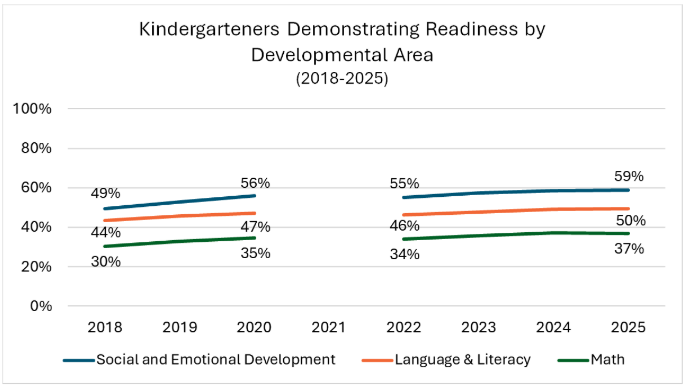
In SY24-25, 31.5% of kindergartners demonstrated readiness in all three developmental areas, holding fairly steady to the prior year and contributing to an arc of steady growth over the 7-year stretch (with the exception of SY21, that was impacted by the pandemic). More youngsters demonstrated readiness for kindergarten in social & emotional development, while just under half were ready in language and literacy development, and just over one-third were on track for math development.
Although there were no major shifts this past year, the data continues to reveal disparities in kindergarten readiness across demographic groups.
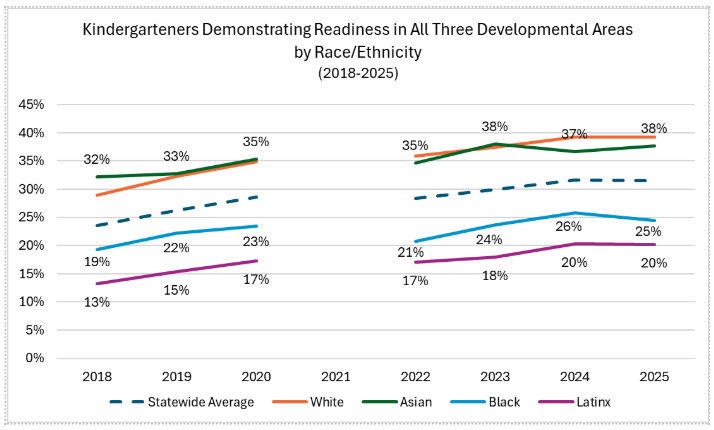
More specifically, KIDS data reveals that gaps across lines of race, income, and learning style begin before children begin formal schooling, emphasizing the need for investments in high-quality early childhood care, services, and education that prioritizes children most in need.
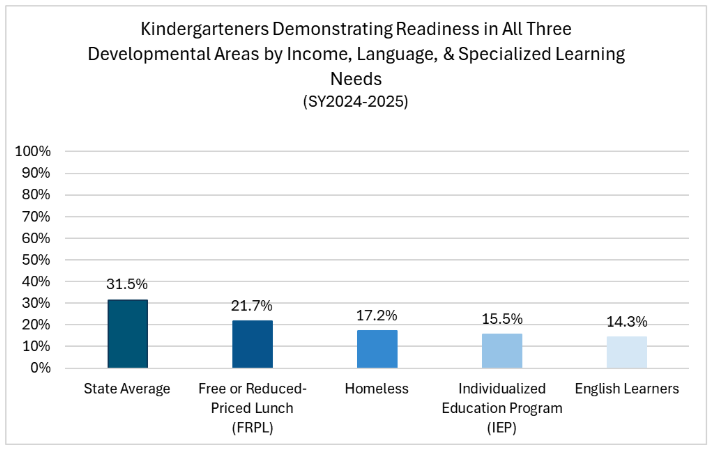
While kindergarten readiness rates dropped across English Learners, children with IEPs, children receiving free or reduced lunch, and children who are homeless in SY24-25, kindergartners from low-income households (FRPL) experienced the most significant drop, declining by 1 full percentage point.*
That being said, although kindergarten readiness rates declined modestly across various student groups last year, the overall level of readiness has improved by more than 8 percentage points since the state first began observing incoming students in 2017. And it is good news that overall readiness for students receiving FRPL has grown by 6 percentage points.
Concerns about the Drop-Off in Response Rate
One area of concern about this year’s KIDS data is the drop-off in the number of children being observed. The percentage of kindergartners observed and assessed decreased statewide for the first time since the pandemic, dropping from 90.9% in SY2023-2024 to 87.1% in SY2024-2025. Among other things, this makes direct comparisons between years more difficult, particularly for the Chicago Public Schools (CPS), where the percentage of kindergartners observed dropped more dramatically from 88% to 73.3% in a single year.
For statewide data to be valid and useful, participation rates need to be high. Importantly, training and coaching help teachers successfully implement this observational tool and so we hope and trust the state will continue to invest in these strategies. In addition to ensuring more accurate information, training and coaching strengthen skills with broader classroom value.
Conclusion
While it is good news that the number of students demonstrating kindergarten readiness has been steadily increasing, the sad fact is that overall rates of readiness across the state remain lower than anyone would like, with just a third of kindergarteners demonstrating readiness in all three assessed developmental areas. This speaks powerfully to the need for significant investment in high-quality early learning and care. As importantly, the persistent gaps that emerge even before children reach kindergarten highlight the need to make equitable investments across the early childhood service spectrum, including in early intervention for very young children with developmental delays and disabilities.
Having statewide data on kindergarten readiness that is comparable across districts is essential for ensuring we understand the overall and more targeted needs facing families and communities. From there, it is up to us to make sure we put that knowledge to work.
—-
*(The data on English Learner kindergarten readiness should be cautiously interpreted given that alternative language assessments are not systematically used across districts. IWERC, Trends and Disparities in Readiness Using KIDS, 2024.)
Kate Buchanan is the Senior Policy Advisor, Early Childhood for Advance Illinois.